Checklist: spot cross-border data transfers clauses before you subscribe
Every time you sign up for a SaaS tool, a cloud storage service, or an AI-powered app, your personal data may travel across continents before you even finish th

Photo by RDNE Stock project from Pexels
Every time you sign up for a SaaS tool, a cloud storage service, or an AI-powered app, your personal data may travel across continents before you even finish the onboarding wizard. Cross-border data transfer clauses buried deep inside terms of service determine which countries can access your information, under what legal framework, and with what safeguards. Missing these clauses can expose you to weaker privacy protections, government surveillance programs, or data-handling standards far below what you expect.
This checklist-style resource gives you a repeatable, step-by-step method to spot those clauses quickly, no law degree required.
TL;DR
- Cross-border data transfer clauses tell you where your data physically goes and which laws protect it there.
- Look for keywords like "Standard Contractual Clauses," "adequacy decision," "sub-processors," and "third-country transfers."
- Services that stay silent on transfer destinations are a bigger red flag than those that disclose them openly.
- A quick pre-subscription scan can save you from privacy surprises months later.
- Terms Doctor's 101 automated checks flag cross-border transfer language so you don't have to read every paragraph yourself.
Why cross-border data transfers matter to you

When a company transfers your data from the EU to the United States, or from Canada to Singapore, the legal protections that applied in your home country may no longer follow your data. The European Union's GDPR, for example, restricts transfers to countries that lack an "adequacy decision", a formal finding that the destination country offers comparable privacy safeguards. Without that decision, the company must rely on mechanisms like Standard Contractual Clauses (SCCs), Binding Corporate Rules (BCRs), or explicit user consent.
For everyday subscribers, the practical impact is real. Your customer-support transcripts, payment details, uploaded files, and usage analytics could be stored on servers in jurisdictions where government agencies can request access without a warrant. If the service's terms don't explain the transfer mechanism, you have no way to evaluate the risk before handing over your credit card.
Key takeaway: If a service's terms of service never mention where your data goes, treat that silence as a red flag, not a reassurance.
Keywords and phrases to search for

Before you open a terms-of-service page, know what you're looking for. Here are the most common phrases that signal a cross-border data transfer clause:
- "Transfer to third countries", the GDPR term for sending data outside the European Economic Area.
- "Standard Contractual Clauses" (SCCs), pre-approved contract templates from the European Commission that companies use to legitimize transfers.
- "Adequacy decision", a reference to the European Commission's list of countries deemed to have sufficient data protection.
- "Sub-processors", third-party vendors the service uses; their locations reveal where your data actually ends up.
- "Binding Corporate Rules" (BCRs), internal policies multinational companies adopt for intra-group transfers.
- "Data Processing Agreement" (DPA), a separate document (often linked from the ToS) that details transfer safeguards.
- "EU-U.S. Data Privacy Framework", the current mechanism allowing transfers from the EU to certified U.S. companies.
- "Derogations", exceptions that allow transfers when no other mechanism applies, often based on your explicit consent.
"Healthcare is the most complex industry...">, Cross
This quote underscores that even heavily regulated industries struggle with cross-border compliance. As an individual subscriber, you deserve the same vigilance, scaled down to a practical checklist.
Your pre-subscription cross-border data transfer checklist
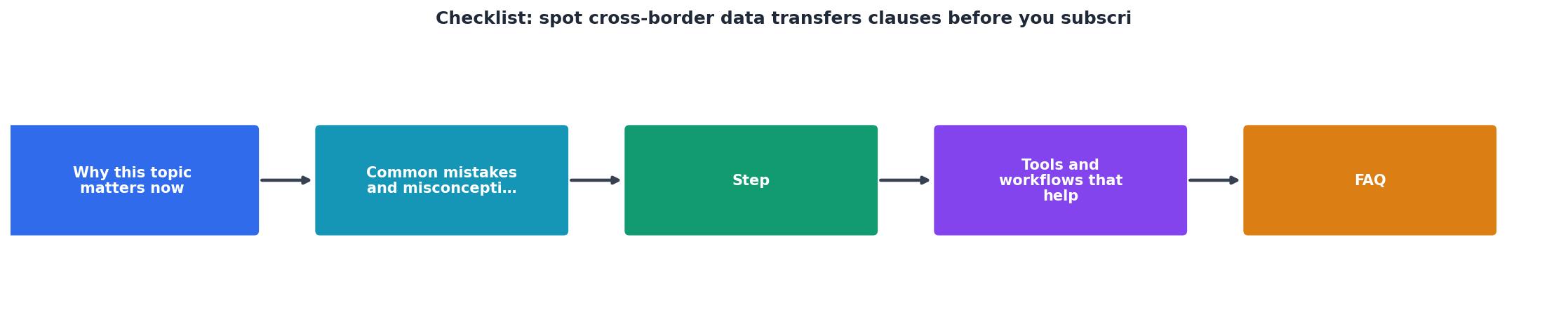
Use this checklist every time you evaluate a new service. Print it, bookmark it, or let Terms Doctor handle the heavy lifting.
Cross-Border Data Transfer Pre-Subscription Checklist
Your progress is saved automatically in your browser.
Step-by-step: how to run the check in under five minutes

- Navigate to the service's website and scroll to the footer. Click "Terms of Service" or "Privacy Policy."
- Press Ctrl+F (or Cmd+F on Mac) and type "transfer." Scan each highlighted result for context about destinations and mechanisms.
- Repeat the search with "sub-processor" and "third country." Many services split transfer details across multiple sections.
- Open the sub-processor list if one exists. Note the countries listed. Compare them against the European Commission's adequacy list if you are in the EU.
- Install Terms Doctor (free for Chrome, Edge, Brave, Opera, and Vivaldi). Click the extension icon on the terms page. Within seconds you'll see an A-F grade, a plain-language summary, and highlighted red-flag clauses, including any cross-border transfer issues.
Red flags that should make you pause
Not every cross-border transfer is dangerous, but certain patterns deserve extra scrutiny:
- No mention of transfers at all, the company either hasn't thought about compliance or is deliberately vague.
- References to invalidated frameworks, if the terms still cite "Privacy Shield" as the sole transfer mechanism, the company may not have updated its legal documents since 2020.
- Blanket consent clauses, phrases like "by using our service you consent to transfers to any country" attempt to bypass proper safeguards.
- No sub-processor list, without one, you cannot verify where your data actually goes.
- Transfers justified solely by "legitimate interest", this basis is contested for cross-border transfers and may not hold up under regulatory scrutiny.
What to do when you find a problem
If your checklist review reveals missing safeguards or vague language, you have several practical options:
- Contact support and ask directly: "Where is my data stored, and what transfer mechanism do you use?" A reputable company will answer clearly.
- Request a DPA, many B2B services provide one on request even if it isn't linked publicly.
- Choose a regional plan, some services (especially cloud storage and project management tools) offer EU-only or region-locked data residency for an additional fee or even at no extra cost.
- Walk away, if the service cannot explain its transfer practices, consider an alternative that can. Terms Doctor's grading makes it easy to compare two competing services side by side.
Frequently Asked Questions
Let Terms Doctor do the heavy lifting
You shouldn't need to memorize legal terminology to protect your privacy. Install the free Terms Doctor extension for Chrome, Edge, Brave, Opera, or Vivaldi, and let it scan every terms page you visit. Its 101 automated checks cover cross-border transfers, forced arbitration, AI training on your data, auto-renewal traps, and dozens more consumer-protection issues, all summarized in a clear A-F grade. Visit the Terms Doctor homepage to get started in under a minute.
Disclaimer: Terms Doctor provides informational analysis, not legal advice. For decisions with significant legal or financial consequences, consult a qualified professional.
Additional Resources
- Cross-Border Data Transfers: Compliance Checklist - Checklist for mapping, classifying, securing and legally verifying healthcare cross-border data transfers, including DOJ, GDPR, HIPAA, ...
- Chapter 13: Cross-Border Data Transfers - A Cross-Border Data Transfer may take place on the basis of ad hoc clauses. These clauses must conform to the requirements of the GDPR, and must be approved by ...
- Cross-Border Data Transfers: A Global Guide to Compliance - Cross-border data transfers involve moving personal data across borders. Learn key legal tools and how to stay globally compliant.
Ready to Read Terms Before You Sign?
Terms Doctor finds terms of service on any site and grades them A-F in seconds.
Get Started“Terms Doctor flagged forced arbitration and AI training clauses in seconds. I finally know what I am agreeing to.”
Privacy-conscious shopper