Checklist: spot perpetual content licences clauses before you subscribe
You upload a photo to a design tool, paste a blog post into an AI writing assistant, or share a video through a social platform, and somewhere in the terms of s

Photo by Jakub Zerdzicki from Pexels
You upload a photo to a design tool, paste a blog post into an AI writing assistant, or share a video through a social platform, and somewhere in the terms of service a single sentence quietly grants that company a perpetual, irrevocable, royalty-free licence to your content. Even after you cancel, your work can be used for advertising, model training, or sublicensing to third parties. These clauses are surprisingly common, and most people never notice them until it is too late.
This resource gives you a practical, step-by-step checklist to identify perpetual content licence clauses before you hit "Subscribe." No law degree required, just a careful eye and the right tools.
TL;DR
- A perpetual content licence lets a service keep using your uploads forever, even after you delete your account.
- Key red-flag phrases include "perpetual," "irrevocable," "royalty-free," "sublicensable," and "worldwide."
- You should check the scope (what content), the purpose (how it's used), and the survival clause (what happens after cancellation).
- Automated tools like Terms Doctor can flag these clauses instantly across 101 consumer-protection checks.
- This checklist is an educational resource, not legal advice, consult a qualified lawyer for binding guidance.
What Is a Perpetual Content Licence?

When you agree to a service's terms, you typically grant the company some level of permission to handle your content, otherwise the platform could not display your photos, process your documents, or stream your videos. That permission is called a content licence.
A perpetual content licence is one that has no expiration date. It survives account deletion, subscription cancellation, and even the company being acquired by another entity. Pair "perpetual" with "irrevocable" and the company does not need your future consent to continue using the content. Add "sublicensable" and the company can pass that licence on to partners, advertisers, or AI model trainers without notifying you.
Why it matters for everyday users
- Freelancers who upload portfolio work to a SaaS design tool may unknowingly let the platform showcase that work in marketing materials, forever.
- Small-business owners who store product photos on a social commerce platform could find those images reused in competitor ads served by the same network.
- Privacy-conscious individuals who paste personal writing into AI assistants may be granting a perpetual licence for that text to train future models.
Key takeaway: A perpetual content licence means the company keeps rights to your content even after you leave, understanding the exact scope of that licence is the single most important step before subscribing.
Red-Flag Phrases to Search For

Before diving into the full checklist, familiarise yourself with the specific language that signals a perpetual content licence. Terms of service are written by lawyers, but the vocabulary is surprisingly consistent across platforms.
- "Perpetual", the licence never expires.
- "Irrevocable", you cannot withdraw permission later.
- "Royalty-free", the company owes you nothing for using your content.
- "Sublicensable", the company can pass the licence to third parties.
- "Worldwide", the licence applies in every jurisdiction on the planet.
- "Transferable", the licence moves with the company if it is sold or merged.
- "User-generated content" or "User Content", the defined term that usually triggers the licence grant.
- "Survive termination", explicitly states the clause outlasts your account.
"Before committing to any contract, it's crucial to understand what you're agreeing to and ensure your interests are fully protected.">, Before Signing a Licensing Agreement: Essential Guide for Influencers
If you spot three or more of these phrases clustered in the same paragraph, you are almost certainly looking at a perpetual content licence clause. The next section turns this knowledge into an actionable checklist.
The Complete Perpetual Content Licence Checklist
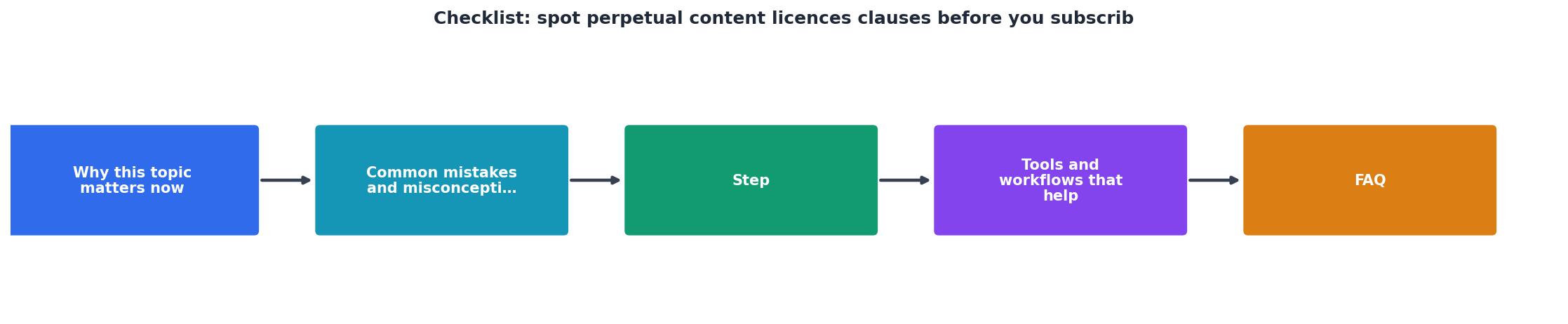
Use this checklist every time you evaluate a new SaaS tool, social platform, or AI service. Work through each item in order, if you check fewer than half the boxes, the terms likely deserve a closer look (or a second opinion from a lawyer).
Perpetual Content Licence Spotting Checklist
Your progress is saved automatically in your browser.
How to work through the checklist step by step
Step 1, Find the terms page. Most services link to their Terms of Service (or Terms of Use) in the website footer. If you cannot find it, paste the site URL into your browser with Terms Doctor installed, the extension automatically discovers the ToS page for you.
Step 2, Locate the content licence section. Use your browser's search function (Ctrl+F) and type "licence" or "license" (check both spellings). Jump to each match and read the surrounding paragraph. The relevant section is usually titled "User Content," "Your Content," or "Intellectual Property."
Step 3, Map the red-flag phrases. For each match, note which of the eight red-flag phrases from the previous section appear. Write them down or highlight them. A clause that says "You grant us a perpetual, irrevocable, worldwide, royalty-free, sublicensable licence to use, reproduce, modify, and distribute your content for any purpose" is the most aggressive version you will encounter.
Step 4, Assess the scope. Does the licence apply to everything you upload, or only content you choose to make public? Some platforms limit the licence to content shared on public profiles, which is narrower and generally less risky.
Step 5, Check the survival clause. Scroll to the "Termination" or "Cancellation" section. Look for language like "The following sections shall survive termination…" and see if the content licence section number is listed.
Step 6, Verify revocation options. Some services state that deleting your content before cancelling your account will end the licence for that specific content. Others explicitly say deletion does not affect previously granted rights. This distinction is critical.
Step 7, Cross-reference with the privacy policy. The privacy policy may describe data retention periods that contradict the perpetual licence in the ToS. Inconsistencies are a red flag in themselves and suggest the company has not carefully considered user rights.
Step 8, Automate the review. Install the free Terms Doctor extension for Chrome, Edge, Brave, Opera, or Vivaldi. Navigate to the service's website, and Terms Doctor will find the ToS, run all 101 consumer-protection checks, including content licence scope, AI training rights, and survival clauses, and present an A-F grade with plain-language explanations of every flagged issue.
Real-World Scenarios Where This Checklist Helps

Scenario 1, AI writing assistant
You paste client briefs and draft articles into an AI tool. The terms grant a perpetual, sublicensable licence to "inputs and outputs." That means the company can use your client's confidential information to train future models and sublicense the resulting model to competitors. Running the checklist would flag "sublicensable" and "inputs" as red flags at Steps 3 and 4.
Scenario 2, Cloud design platform
A freelance graphic designer uploads original illustrations. The terms limit the licence to "operating and promoting the service." That sounds reasonable, until you notice the survival clause at Step 5 says the licence persists after deletion. Your illustrations could appear in the platform's advertising years after you switch to a competitor.
Scenario 3, Social commerce marketplace
A small-business owner lists handmade products with original photography. The terms grant a perpetual licence but only for "publicly posted content." At Step 4 of the checklist, you would note the narrower scope. However, since every product listing is public by nature, the practical effect is still a perpetual licence over all your product photos.
What to Do If You Find a Perpetual Licence Clause
Not every perpetual licence is a deal-breaker, but you should make an informed decision. Here is a quick action plan:
- Assess the risk. If you are uploading low-sensitivity content (e.g., public blog posts), a perpetual licence may be acceptable. For confidential client work or original creative assets, the risk is much higher.
- Look for alternatives. Use Terms Doctor's A-F grading to compare competing services. A tool graded B or C for content rights may be a better fit than one graded F.
- Negotiate if possible. Enterprise and business plans sometimes come with modified terms. Ask the vendor's sales team whether the perpetual licence can be scoped down or removed.
- Limit what you upload. Use placeholder content during free trials. Only upload production assets once you are satisfied with the terms.
- Monitor for changes. Terms of service can change at any time. Terms Doctor's change-tracking feature alerts you when a service updates its ToS, so you can re-run the checklist.
FAQ
Frequently Asked Questions
Protect Your Content Before You Click "Agree"
Perpetual content licence clauses are not going away, if anything, the rise of AI training and data-hungry platforms is making them more common and more aggressive. The good news is that spotting them takes minutes, not hours, especially when you combine a manual checklist with automated scanning. Install the free Terms Doctor extension for Chrome, Edge, Brave, Opera, or Vivaldi, and let it run 101 consumer-protection checks on every terms page you visit. Pair that with the checklist above, and you will never unknowingly sign away your content rights again.
Reminder: This article is an educational resource and does not constitute legal advice. For binding guidance on content licensing, consult a qualified legal professional.
Additional Resources
- Before Signing a Licensing Agreement: A Guide for Influencers - Perpetual or Irrevocable Rights: Be wary of contracts that grant indefinite or non-cancellable rights to your content or likeness. Check the duration and scope ...
- Let's talk about another type of Usage Rights that I consider to ... - Perpetual Usage is when you release all your rights to your own content for forever. The brand can do whatever they want to your content, use it ...
- What Is a Content Licensing Agreement? - Define all critical terms in your content licensing agreements including the specific grant of license, geographic territory, duration, payment ...
Ready to Read Terms Before You Sign?
Terms Doctor finds terms of service on any site and grades them A-F in seconds.
Get Started“Terms Doctor flagged forced arbitration and AI training clauses in seconds. I finally know what I am agreeing to.”
Privacy-conscious shopper