Terms of service template notes for B2B SaaS founders
If you're launching a B2B SaaS product, your terms of service (ToS) are one of the most overlooked yet legally critical documents you'll publish. Most founders

Photo by RDNE Stock project from Pexels
If you're launching a B2B SaaS product, your terms of service (ToS) are one of the most overlooked yet legally critical documents you'll publish. Most founders grab a template, change the company name, and call it done, but that approach exposes you and your customers to disputes, regulatory fines, and trust erosion. This guide walks you through what a solid B2B SaaS ToS template should contain, why each section matters, and how to adapt it to your specific product and market.
TL;DR
- A B2B SaaS ToS template should clearly define your service scope, uptime expectations, acceptable use, payment terms, and liability limits to protect both your company and your customers.
- Key sections include user responsibilities, data handling, IP ownership, termination rights, dispute resolution, and limitation of liability, all written in plain language your users can actually understand.
- Common red flags in pre-written templates include overly broad IP claims, hidden auto-renewal terms, forced arbitration without customer opt-out, and vague uptime guarantees.
- Use Terms Doctor to scan how your final ToS compares to industry standards and spot clauses that may trigger automated consumer-protection warnings.
- Never copy a template wholesale; customize it for your specific jurisdiction, payment model, and product complexity to avoid future contract disputes.
Why Your B2B SaaS Needs a Real Terms of Service

Many early-stage founders think ToS is boilerplate, a checkbox before launch. In reality, it's your first line of defense against liability, compliance violations, and relationship breakdown with customers.
A well-drafted ToS accomplishes several critical things:
- Sets legal boundaries. It clarifies what your service does and does not do, limiting your liability if something goes wrong.
- Protects intellectual property. It establishes who owns code, data, and custom work your customer creates or uploads.
- Defines payment obligations. It prevents disputes over billing cycles, refund eligibility, and subscription changes.
- Establishes user responsibilities. It makes clear that customers cannot use your service to spam, hack, or violate laws.
- Enables enforcement. Without clear terms, you have no contractual basis to suspend a user, freeze data, or pursue damages.
Core Sections Every B2B SaaS ToS Must Include
A complete B2B SaaS terms of service template typically contains these sections:
1. Service Description and Scope
Define exactly what your product does and what it doesn't promise. This is your most important liability shield.
Example language:- "We provide a cloud-based project management platform for team collaboration. We do not provide legal, financial, or medical advice."
- Specify any geographic or regulatory limits (e.g., "Not available in the EU without GDPR compliance").
2. User Eligibility and Account Responsibility
Clearly state who can use your service and hold users accountable for account security.
Must-haves:- Minimum age requirement (18+, or 13+ with parental consent if applicable).
- User acknowledgment that they are responsible for maintaining password secrecy.
- Confirmation that the account holder is legally authorized to bind their organization to the terms.
3. Acceptable Use Policy
Define what users cannot do on your platform. Common prohibitions include:
- Hacking, reverse-engineering, or circumventing security measures.
- Uploading illegal content or using the service for illegal purposes.
- Scraping, crawling, or bulk downloading data without permission.
- Interfering with network integrity or other users' access.
- Transmitting malware or launching attacks.
4. Payment, Billing, and Refunds
This section prevents recurring billing disputes. Be explicit:
- Billing cycle: "Monthly on the 1st; annual plans billed upfront."
- Auto-renewal: "Your subscription automatically renews unless you cancel before the renewal date."
- Refund policy: "Monthly plans: no refunds for partial months. Annual plans: pro-rata refund if cancelled within 14 days of purchase."
- Price changes: "We may increase prices with 30 days' notice. Existing subscriptions renew at old prices for one renewal cycle."
5. Data and Privacy Handling
While detailed privacy handling goes in a separate Privacy Policy, your ToS should clarify:
- Data ownership: "Customer data belongs to the customer. We may not use it for marketing or AI training without explicit written consent."
- Data retention post-termination: "We retain archived data for 30 days after account closure to allow recovery. After 30 days, all data is permanently deleted."
- Subprocessors and third parties: "We use AWS for hosting and Stripe for payments. See our Data Processing Addendum (DPA) for full details."
- Security baseline: "We maintain industry-standard security controls including encryption in transit and at rest."
6. Intellectual Property
Clarify who owns what:
- Customer content: "You retain all rights to content you upload. By using our service, you grant us a license to process, store, and display your content to fulfill our service."
- Your IP: "Terms Doctor, all software, features, and functionality are owned by or licensed to us. You may not copy, modify, or reverse-engineer them."
- Feedback: "Any feedback you provide, we may use freely without obligation or compensation."
7. Uptime and Service Level Expectations
This is where many templates go vague, and customers get frustrated. Be specific:
"Uptime or availability (while we strive for high availability, we do not guarantee 99.9% uptime or any specific uptime percentage unless you have a separate Service Level Agreement).">, SaaS Terms of Service Template for Startups (2025)
Better approach: Either offer an SLA with defined uptime percentages and remedies (service credits), or admit you don't guarantee specific uptime and exclude yourself from liability for outages. Customers respect honesty over false guarantees.
8. Limitation of Liability
This section limits how much you can be sued for:
- "Our total liability shall not exceed the fees you paid us in the 12 months preceding the claim."
- "We are not liable for lost profits, lost data, lost revenue, or indirect, incidental, or consequential damages."
9. Termination and Suspension
Define the conditions under which either party can end the relationship:
- Termination for convenience: "Either party may terminate with 30 days' notice."
- Termination for cause: "We may immediately suspend your account if you violate this ToS or applicable law."
- Data upon termination: "Upon termination, we will provide a one-time export of your data within 14 days. After that, we delete all data."
10. Dispute Resolution
This section defines how disagreements are handled. Common options include:
- Litigation in a specific jurisdiction: "Any dispute shall be resolved in the courts of California."
- Binding arbitration: "Disputes shall be resolved by binding arbitration under JAMS rules, not court litigation."
- Mediation first: "Parties shall attempt mediation before pursuing litigation or arbitration."
Red Flags to Avoid in ToS Templates

When adapting a template, watch for these common pitfalls:
- Auto-renewal hidden in fine print: If your pricing includes auto-renewal, state it clearly upfront, not buried in paragraph 47. Regulators and customers notice.
- Overly broad IP claims: Don't claim ownership of customer data or work product. You only need a license to operate the service.
- Vague uptime guarantees: "We strive for reliability" is not a promise. Either commit to a percentage or admit you don't guarantee uptime.
- One-sided modification rights: "We may change these terms anytime" without notice or opt-out can make your ToS unenforceable. Include reasonable notice and let customers cancel if they disagree.
- Mandatory arbitration without opt-out: Many B2B buyers refuse to sign ToS that force arbitration. Consider allowing opt-out or litigation as an alternative.
- Liability caps that are too high: If your cap equals more than one year of revenue, it defeats the purpose. Keep it proportional.
- Lack of data deletion promise: Customers want assurance their data disappears after they leave. Commit to a specific retention period.
- Unclear acceptable use policy: Don't just say "no illegal use." Specify what behavior triggers suspension: spamming, hacking, scraping, DDoS, etc.
How to Customize a Template for Your Product

Using a template is smart, starting from scratch is slow and error-prone. But copying a template wholesale is asking for trouble. Follow this process:
ToS Template Customization Checklist
Your progress is saved automatically in your browser.
Step-by-Step Customization Process
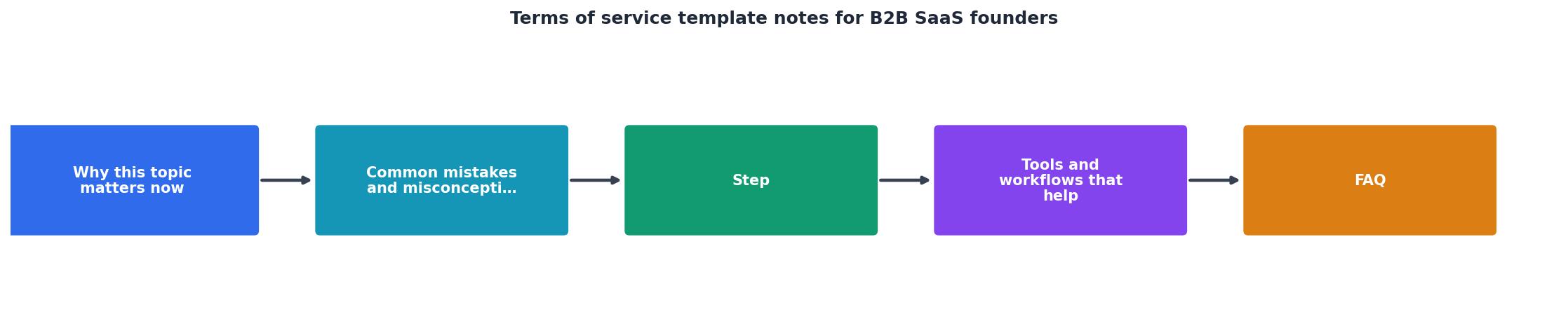
- Start with a reputable template. Sources like Stripe, GitHub, and legal-tech platforms publish templates aligned with modern B2B practices.
- Map your product specifics. Go section by section and ask: Does this apply to us? Can we commit to this? If not, rewrite it.
- Consult your payment model. Monthly subscriptions, annual contracts, usage-based billing, and freemium all have different ToS implications. Align your terms to your billing.
- Check your jurisdiction. If you serve customers in California, the EU, or the UK, additional compliance rules (GDPR, CCPA, UK Online Safety Bill) may override your ToS. Flag these and add disclaimers.
- Get legal eyes. Have a lawyer review the final version, especially the liability and dispute resolution sections. Spending $500–$2,000 on a review now saves $50,000 in litigation later.
- Scan with Terms Doctor. Run your published ToS through the free Terms Doctor extension to see how it grades and which clauses trigger automated red flags. Use this feedback to clarify ambiguous language.
- Test with a customer. Share your draft ToS with a trusted early customer and ask for feedback. If they flag language as confusing or unfair, rewrite it.
Common Questions About B2B SaaS ToS
FAQ
Frequently Asked Questions
Final Checks Before Publishing
Before you ship your ToS, run this validation:
- Is it in plain language? A lawyer should be able to read it, but so should your customer. Avoid legalese jargon where possible.
- Does it match your actual product? If you claim uptime but your infrastructure doesn't support it, rewrite it.
- Is it enforceable? Overly one-sided terms (e.g., we can change anything anytime, customers have no recourse) may be thrown out in court.
- Have you covered liability? Include a clear liability cap and exclusion for indirect damages.
- Is data handling transparent? Specify what you do with customer data, who has access, and how long you keep it.
- Does it reflect your payment model? Auto-renewal, refund policy, and price changes should be crystal clear.
Using Terms Doctor to Validate Your ToS
Once your ToS is live, use the free Terms Doctor browser extension to scan it for hidden red flags. Terms Doctor runs 101 consumer-protection checks against your terms, including:
- Forced arbitration without opt-out
- Auto-renewal without clear disclosure
- Overly broad liability exclusions
- Vague uptime guarantees
- AI training on user data without consent
- Unclear data retention and deletion practices
Remember: Terms Doctor's automated checks are not legal advice, and no tool can replace a lawyer's review of your specific situation. But combined with legal counsel, Terms Doctor helps you spot common pitfalls and ensure your ToS is both fair and defensible.
Building trust with B2B customers starts with a ToS that's honest, transparent, and easy to understand. Spend the time to get it right at launch, it's one of the best investments you'll make in your company's long-term credibility and legal health.
Additional Resources
- SaaS Terms of Service Template for Startups (2025) - A comprehensive, legally sound Terms of Service (TOS) template for SaaS startups. This template covers subscription terms, licensing, acceptable use, limitation ...
- SaaS Terms & Conditions Template - A Terms and Conditions agreement is where you set the rules and guidelines that your customers must follow in order to access the service you ...
- What goes into a SaaS contract playbook - A contract playbook can cover as many terms as you want. This contract playbook template covers the big ones and shows how you might structure ...
Ready to Read Terms Before You Sign?
Terms Doctor finds terms of service on any site and grades them A-F in seconds.
Get Started“Terms Doctor flagged forced arbitration and AI training clauses in seconds. I finally know what I am agreeing to.”
Privacy-conscious shopper