Checklist: spot class action waivers clauses before you subscribe
Buried deep inside the terms of service you click "I agree" on, there is often a single paragraph that strips away one of your most effective consumer rights: t


Photo by Jakub Zerdzicki from Pexels
Buried deep inside the terms of service you click "I agree" on, there is often a single paragraph that strips away one of your most effective consumer rights: the ability to join a class action lawsuit. A class action waiver means that if the company overcharges thousands of users by a few dollars each, none of you can band together in court, you must fight alone, usually through private arbitration. This checklist will teach you exactly what to look for, where to look, and what to do once you find these clauses, all before you hand over your credit card.
TL;DR
- A class action waiver forces you to resolve disputes individually, blocking you from joining group lawsuits against a company.
- These clauses hide in sections labeled "Dispute Resolution," "Arbitration," or "Legal Terms", rarely under a clear heading.
- Opt-out windows exist in many agreements but typically expire 30 days after you sign up.
- Knowing the exact phrases to search for can save you from unknowingly surrendering your rights.
- Tools like Terms Doctor automatically flag class action waivers as part of their 101 consumer-protection checks.
What Is a Class Action Waiver and Why Should You Care?

A class action waiver is a contractual clause in which you agree not to participate in a class action, collective action, or representative action against the company. Instead, any legal dispute must be handled on an individual basis, almost always through binding arbitration rather than a public courtroom.
Why companies include them
Class action lawsuits are expensive for businesses. A single case can aggregate thousands of small claims into one massive proceeding, resulting in significant settlements and public scrutiny. By inserting a waiver, companies ensure that each customer must file a separate arbitration claim. Because the cost and effort of individual arbitration often exceed the amount in dispute, most consumers simply never pursue their claims at all.
Why this matters to you
- Small harms go unaddressed. If a streaming service quietly charges you an extra $2 per month, the $24 annual loss is not worth a solo legal fight, but multiplied across millions of subscribers, it is a massive windfall for the company.
- No public accountability. Arbitration proceedings are private. There is no public record, no precedent set, and no media coverage to pressure the company into changing its behavior.
- Power imbalance. The company picks the arbitration provider, sets the rules, and has a team of lawyers on retainer. You are on your own.
Key takeaway: A class action waiver quietly removes your strongest collective bargaining tool as a consumer, spotting it before you subscribe is the only reliable defense.
The Language They Use: Key Phrases to Search For

Companies rarely title a section "Class Action Waiver." Instead, the language is woven into broader dispute-resolution or arbitration sections. Here are the exact phrases and keywords you should search for (use Ctrl+F or Cmd+F) when reading any terms of service:
- "class action waiver", The most direct phrase, but not always present.
- "waive any right to participate in a class action", A common full-sentence formulation.
- "on an individual basis only", Signals that collective proceedings are barred.
- "no class or representative proceedings", Explicitly bans class and representative actions.
- "you agree that any dispute … will be resolved individually", Often the opening line of the waiver paragraph.
- "binding arbitration", While not a waiver itself, binding arbitration clauses almost always contain a class action waiver within the same section.
- "JAMS" or "AAA" (American Arbitration Association), References to specific arbitration providers confirm an arbitration clause is present; check the surrounding paragraphs for the waiver.
- "small claims court", Many waivers include an exception for small claims court, which can be a clue that the broader clause exists.
- "representative action" or "collective action", Broader terms that cover class actions and similar proceedings.
- "opt-out", If you see this near arbitration language, there may be a time-limited window to reject the waiver.
"The following checklist identifies key issues employers may want to consider when adopting a class action waiver in an employment arbitration agreement.">, An Epic Checklist: What to Consider When Adopting Class Action Waivers in Employ
While the quote above addresses employment agreements, the same structural concerns apply to consumer terms of service. The clauses use nearly identical language regardless of context.
Step-by-Step: How to Spot and Evaluate a Class Action Waiver
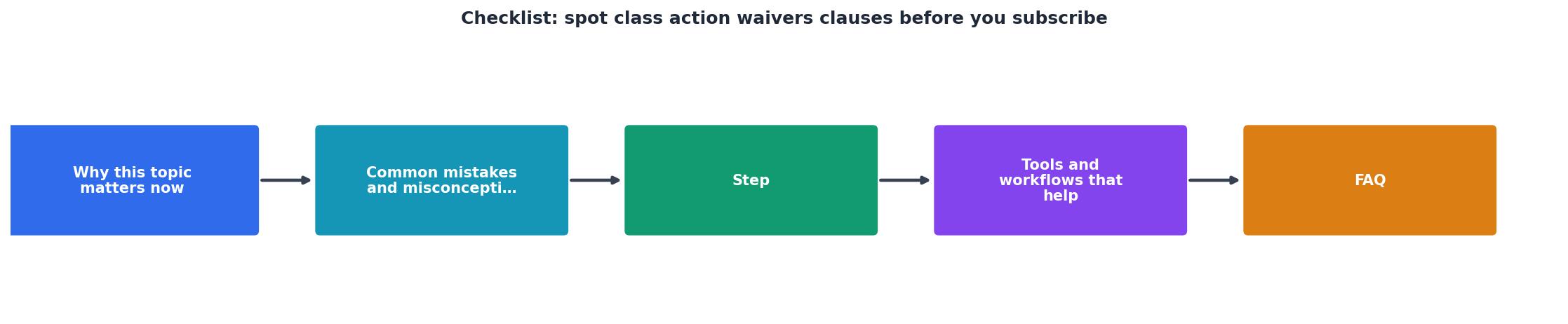
Follow these steps every time you consider subscribing to a new service:
- Locate the terms of service. Look for links labeled "Terms of Service," "Terms of Use," "User Agreement," or "Legal", usually in the website footer or on the sign-up page.
- Search for the dispute resolution section. Use
Ctrl+Fand type "dispute," "arbitration," or "class action." Jump to each match. - Read the full arbitration section. Do not stop at the first sentence. Class action waivers are often buried in the middle or end of a multi-paragraph arbitration clause.
- Identify the waiver language. Look for any of the key phrases listed above. Highlight or copy the exact sentence for your records.
- Check for an opt-out provision. Many companies (especially those based in the US) include a 30-day opt-out window. Note the deadline, the required method (usually email or physical mail), and the exact address.
- Evaluate the arbitration provider. If the clause names JAMS, AAA, or another provider, visit their website to understand the filing fees and rules. Some providers have consumer-friendly fee schedules; others do not.
- Compare with alternatives. If the waiver is a dealbreaker, check whether a competing service has more favorable terms. Terms Doctor's A-F grading makes this comparison fast.
- Exercise your opt-out if needed. If you decide to subscribe but want to preserve your class action rights, send the opt-out notice before the deadline expires. Keep a copy of your correspondence.
Your Pre-Subscription Class Action Waiver Checklist

Use this checklist before clicking "I agree" on any new subscription or service:
Pre-Subscription Class Action Waiver Checklist
Your progress is saved automatically in your browser.
Common Red Flags Beyond the Waiver Itself
A class action waiver rarely exists in isolation. When you spot one, look for these additional red flags in the same agreement:
- Mandatory binding arbitration with no small claims exception. Some agreements remove even the small claims court carve-out, leaving you with zero affordable legal options.
- Confidentiality clauses on arbitration outcomes. If the arbitration result is confidential, the company can lose repeatedly and no one else will ever know.
- Unilateral amendment rights. A clause that says "we may update these terms at any time without notice" means the company can add or tighten a waiver after you have already subscribed.
- Shortened statute of limitations. Some terms require you to file a claim within 6 months or even 30 days, far shorter than the legal default.
- Fee-shifting provisions. Clauses that make you pay the company's legal fees if you lose arbitration create a chilling effect on legitimate claims.
- Venue selection. Requiring arbitration in a specific city (often the company's headquarters) adds travel costs that discourage consumers from filing.
What You Can Actually Do About It
Spotting a class action waiver is only half the battle. Here is what you can do once you find one:
Exercise the opt-out
Many major services, including several large streaming platforms, cloud storage providers, and social media networks, include a 30-day opt-out window. The opt-out typically requires you to send a written notice (email or letter) that includes your name, account email, and a clear statement that you reject the arbitration and class action waiver provisions. This does not cancel your subscription; it only preserves your legal rights.
Choose services with better terms
Competition is your leverage. If two project management tools offer similar features but one has an A grade on Terms Doctor and the other has a D, the choice is clear. Voting with your wallet, and telling the company why you left, sends a signal that terms matter.
Stay informed about changes
Companies update their terms regularly, and a service that had no class action waiver last year may add one tomorrow. Terms Doctor's change-tracking feature alerts you when terms you have previously reviewed are modified, so you never miss a critical update.
Know the limits
This checklist and the information in this article are educational resources, not legal advice. If you are facing a specific dispute or need to understand how a class action waiver applies to your situation, consult a licensed attorney in your jurisdiction.
Frequently Asked Questions
Protect Yourself Before You Click "I Agree"
Reading terms of service cover to cover is unrealistic for most people, and companies know it. That is exactly why tools that automate the review process exist. The free Terms Doctor browser extension works on Chrome, Edge, Brave, Opera, and Vivaldi. It finds the terms of service on any site you visit, runs 101 consumer-protection checks (including class action waivers, forced arbitration, auto-renewal traps, and AI data-training clauses), and gives you a clear A-F grade with plain-language explanations. Install it once and you will never blindly agree to a class action waiver again.
Disclaimer: This article is an educational resource and does not constitute legal advice. Automated checks are not a substitute for professional legal counsel.
Additional Resources
- An Epic Checklist: What to Consider When Adopting Class ... - The following checklist identifies key issues employers may want to consider when adopting a class action waiver in an employment arbitration agreement.
- Class Action Waivers in Terms & Conditions - This clause can be a simple statement that says users cannot start or join a class action against you. Make sure to get users to agree to or ...
- The 8-Point Contract Review Checklist | Redline - Use this 8-point contract review checklist to spot red flags in liability, IP, termination, and payment clauses before you sign.
Ready to Read Terms Before You Sign?
Terms Doctor finds terms of service on any site and grades them A-F in seconds.
Get Started“Terms Doctor flagged forced arbitration and AI training clauses in seconds. I finally know what I am agreeing to.”
Privacy-conscious shopper