Checklist: spot AI training on user data clauses before you subscribe
You found the perfect SaaS tool, the pricing looks right, and the feature list checks every box. But buried somewhere in the terms of service is a clause that g

Photo by Darlene Alderson from Pexels
You found the perfect SaaS tool, the pricing looks right, and the feature list checks every box. But buried somewhere in the terms of service is a clause that grants the company a perpetual, royalty-free license to use your data, including prompts, uploads, and outputs, to train its AI models. If you have ever wondered whether a service quietly feeds your content into a machine-learning pipeline, this checklist is for you.
TL;DR
- Many SaaS and AI platforms include clauses that let them train models on your inputs, outputs, or usage data, often buried deep in the terms.
- Look for specific trigger phrases like "machine learning," "model improvement," and "aggregate data" in the terms of service.
- Check whether the service offers an opt-out toggle and whether opting out actually removes your data from existing training sets.
- Free tiers almost always have weaker data protections than paid plans, read both sets of terms.
- Tools like the free Terms Doctor extension can automatically flag AI-training clauses across 101 consumer-protection checks so you never miss one.
Why AI Training Clauses Matter More Than Ever

The generative-AI boom has turned user data into one of the most valuable commodities on the internet. Every prompt you type into a chatbot, every image you upload to an editing tool, and every document you paste into a summarizer could become training material for the next version of that company's model. This is not hypothetical, several major platforms have updated their terms in the past two years to explicitly claim the right to use customer content for model improvement.
For individual users, this means your private notes, business strategies, or creative work could end up influencing outputs served to competitors. For freelancers and small-business owners, it means client-confidential data might be processed in ways that violate your own agreements with those clients. And for anyone who values privacy, it means the service you are paying for might be extracting additional value from you without clear consent.
The problem is compounded by the fact that these clauses are rarely written in plain language. They hide behind phrases like "service improvement," "aggregate and de-identified data," or "feedback." Unless you know exactly what to look for, you will scroll right past them.
Key takeaway: AI-training clauses are increasingly common in SaaS terms of service, and missing them can expose your personal or client data to model training pipelines you never agreed to.
The Trigger Phrases: What to Search For

Before you sign up for any new tool, open the terms of service (or privacy policy) and search for these keywords and phrases. Each one can signal that the company reserves the right to use your data for AI or machine-learning purposes:
- "Machine learning", The most direct signal. If the terms mention machine learning in connection with user content, read the surrounding sentences carefully to understand scope.
- "Model improvement" or "model training", Often found in AI-specific products. This phrase typically means your inputs or outputs feed directly into the training pipeline.
- "Service improvement", A broader, more ambiguous phrase. It can cover traditional analytics, but increasingly it is used as a catch-all that includes AI training.
- "Aggregate data" or "de-identified data", Companies argue that stripping personal identifiers makes data fair game. However, research has shown that de-identified data can sometimes be re-identified, especially when combined with other datasets.
- "Feedback", Some terms define every interaction you have with the product as "feedback" and then claim a broad license to use feedback for any purpose, including training.
- "Perpetual, irrevocable, royalty-free license", This licensing language means the company keeps the right to use your data even after you delete your account or cancel your subscription.
- "Inputs and outputs", Particularly common in generative-AI tools. If the terms claim rights over both what you put in and what the model produces for you, the scope is extremely wide.
- "Third-party models" or "sub-processors", This indicates your data might not only train the company's own models but could also be shared with external AI providers.
"The challenge for most teams is determining what exactly qualifies as personal data.">, GDPR for AI Training Data: Legal Bases and Checklist
When you spot any of these phrases, do not stop reading. Look at the surrounding context: does the clause apply to all users or only free-tier users? Is there an opt-out mechanism? Does opting out actually delete data already collected, or does it only apply going forward? These details make all the difference.
Your Pre-Subscription Checklist
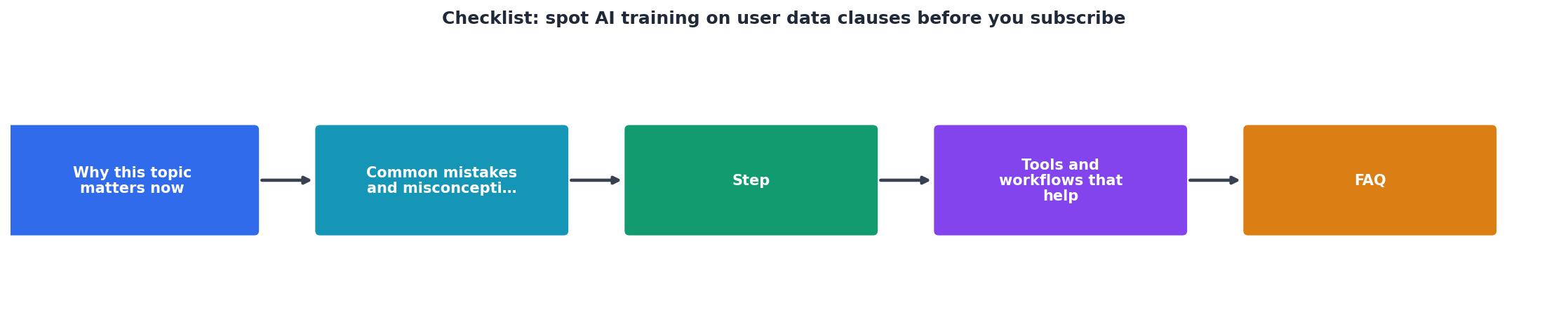
Use this checklist every time you evaluate a new SaaS product, AI tool, or online platform. Print it, bookmark it, or keep it open in a tab alongside the terms you are reviewing.
Pre-Subscription AI Training Clause Checklist
Your progress is saved automatically in your browser.
Free Tier vs. Paid Tier: The Hidden Difference

One of the most common patterns in the industry right now is a split between free-tier and paid-tier data rights. On the free plan, the company retains broad rights to use your data for training. On the paid plan, especially enterprise tiers, those rights are restricted or removed entirely. This makes sense from the company's perspective: free users "pay" with their data, while paying customers get stronger protections.
The problem is that this distinction is rarely made obvious. You might need to compare two separate documents (the general ToS and an enterprise data processing agreement) to understand the difference. Some companies bury the distinction in a help-center article rather than the legal text itself.
Here is what to watch for:
- Separate terms documents, If the company has a "Business Terms" or "Enterprise DPA" in addition to the standard ToS, compare both. The standard ToS often applies to free and individual paid plans.
- "Customer Content" definitions, Some companies define "Customer Content" narrowly for enterprise users (covering everything you upload) but broadly for free users (covering content plus metadata, usage patterns, and derived data).
- API vs. consumer product, If you use a tool through its API, the terms may differ from the consumer-facing web app. API terms sometimes offer a no-training guarantee that the web app does not.
What to Do When You Find an AI Training Clause
Finding a clause does not necessarily mean you should abandon the tool. It means you need to make an informed decision. Here is a step-by-step approach:
- Assess the scope. Does the clause cover all your content, or only specific categories like usage analytics? A clause that trains on anonymized click patterns is very different from one that trains on the full text of your documents.
- Test the opt-out. If an opt-out exists, activate it immediately, even before you start using the tool. Then verify in your account settings that the change has taken effect.
- Contact support. If the terms are ambiguous, email the company's privacy or legal team and ask directly: "Does your company use my inputs or outputs to train AI models? Can I opt out?" Save the response.
- Evaluate alternatives. If the clause is too broad and there is no opt-out, check whether a competitor offers similar functionality with better data terms. Use Terms Doctor to compare the grades of competing services side by side.
- Document your decision. If you are a freelancer or work with clients, keep a record of which tools you evaluated, what their AI-training terms say, and why you chose (or rejected) each one. This protects you if a client ever asks how their data is handled.
How Terms Doctor Helps You Catch What You Miss
Reading terms of service manually is time-consuming and error-prone. The average ToS document runs thousands of words, and AI-training clauses can appear in unexpected sections, sometimes in the privacy policy, sometimes in a separate data processing addendum, and sometimes in a help-center FAQ that is incorporated by reference.
The free Terms Doctor browser extension (available for Chrome, Edge, Brave, Opera, and Vivaldi) automates this process. When you visit any website, it locates the terms of service, runs 101 consumer-protection checks, including specific checks for AI training on user data, and assigns an A-F grade with plain-language explanations. Red-flag clauses are highlighted so you can jump straight to the sections that matter. And with change tracking, you will know if a company quietly updates its terms after you have already subscribed.
Frequently Asked Questions
Disclaimer: The information in this article is for educational purposes only and does not constitute legal advice. Always consult a qualified professional for legal questions specific to your situation.
Additional Resources
- Understanding Training Data in Contracts with AI Vendors - Here is a list of top 3 contract reviewing tips to consider when working with an AI Vendor that wants Training Data from the customer: Customer ...
- AI Considerations for Data Privacy Contracts - This checklist can be used for data privacy lawyers to review AI considerations when working on privacy contract matters.
- GDPR for AI Training Data: Legal Bases and Checklist - Learn how the GDPR applies to AI use, which legal bases are valid, and how to build a compliant AI data strategy for your business.
Ready to Read Terms Before You Sign?
Terms Doctor finds terms of service on any site and grades them A-F in seconds.
Get Started“Terms Doctor flagged forced arbitration and AI training clauses in seconds. I finally know what I am agreeing to.”
Privacy-conscious shopper