Refund policy review checklist for marketplaces teams
A clear, fair refund policy is the backbone of trust in any marketplace. Whether you operate a SaaS platform, freelancer network, digital marketplace, or vendor listing site, your refund policy directly influences buyer confidence, legal compliance, and long-term retention. Yet many marketplace teams rush through policy drafting, copy competitor language without adaptation, or leave loopholes that create disputes later.

Photo by Pavel Danilyuk from Pexels
A clear, fair refund policy is the backbone of trust in any marketplace. Whether you operate a SaaS platform, freelancer network, digital marketplace, or vendor listing site, your refund policy directly influences buyer confidence, legal compliance, and long-term retention. Yet many marketplace teams rush through policy drafting, copy competitor language without adaptation, or leave loopholes that create disputes later.
This guide walks you through a practical checklist to audit, draft, and refine refund policies that protect both your business and your users, without legal jargon.
TL;DR
- A clear refund policy reduces disputes, builds buyer trust, and improves your Terms Doctor grade by addressing consumer-protection flags.
- Document refund windows, dispute procedures, and exclusions in plain language; avoid vague terms like "reasonable time."
- Test your policy against common scenarios (partial refunds, digital goods, subscription cancellations) before launch.
- Use a step-by-step review process to involve legal, customer support, and product teams.
- Automate policy discovery and version tracking with tools like Terms Doctor to stay compliant across marketplace updates.
Why marketplace teams need a refund policy review process

A refund policy is more than a legal requirement, it's a customer-service tool. Buyers scroll past your homepage copy and product features to ask one question: What happens if this doesn't work?
Without a clear policy, your support team spends hours answering the same questions. Worse, frustrated customers leave bad reviews, chargeback disputes escalate, and regulators notice inconsistencies between your marketing and your actual practices.
Marketplace platforms face unique refund challenges:- Multiple actors (buyer, seller, marketplace operator) complicate refund flows.
- Regulatory fragmentation means EU, US, UK, and other jurisdictions have different expectations.
- Digital vs. physical goods require different refund windows and conditions.
- Subscription auto-renewal often hides refund rights in dense terms.
Understanding refund policy scope and categories
Before drafting, map what your marketplace actually offers:
- Physical goods – Shipped items subject to return windows (commonly 14–30 days).
- Digital products – E-books, templates, courses; often non-refundable once downloaded.
- Services – Freelance work, consultations; refundable if incomplete or unsatisfactory.
- Subscriptions – Monthly/annual memberships; often require cancellation notice and prorated refunds.
- Mixed – Bundles combining digital and physical elements.
Each category carries different consumer-protection rules. For example, EU law (Consumer Rights Directive) grants 14-day "cooling-off" rights on most digital purchases, unless the consumer explicitly agreed that the service begin before the 14-day window closed. The US has no federal refund mandate for digital goods, but platforms must honor their own stated policy and avoid deceptive practices under the FTC Act.
Example: A marketplace selling online courses might allow refunds within 7 days of purchase if the course hasn't started, but deny refunds after the first lesson is accessed. This specificity prevents disputes and aligns with most regional regulations.
Core elements of a sound refund policy

A refund policy must clearly answer these questions:
Refund window
- Specify the exact number of days (e.g., "30 days from purchase date," not "reasonable time").
- State how the window is calculated (from order confirmation, delivery, or first access).
- Address partial or staggered services (e.g., courses with modules released over weeks).
Refundable scenarios
- Full refund: service not rendered, incorrect item, significant defect, buyer changed mind (within window).
- Partial refund: partial completion, partial use, or partial delivery.
- Store credit: alternative to refund for certain products.
Non-refundable scenarios
- Buyer misuse or breach of terms.
- Digital product downloaded and consumed beyond the window.
- Customized or made-to-order goods delivered to specification.
- Seller dispute or fraud claim (hold pending investigation).
Refund method and timeline
- Original payment method, store credit, or alternative method.
- Processing time (e.g., "within 5–10 business days after approval").
- Whose responsibility if a refund is delayed (marketplace vs. payment processor).
Dispute and appeal process
- Step-by-step procedure to request a refund (e.g., submit ticket with proof).
- Timeline for marketplace to review and respond (e.g., 5 business days).
- Escalation path if buyer or seller disagrees with the decision.
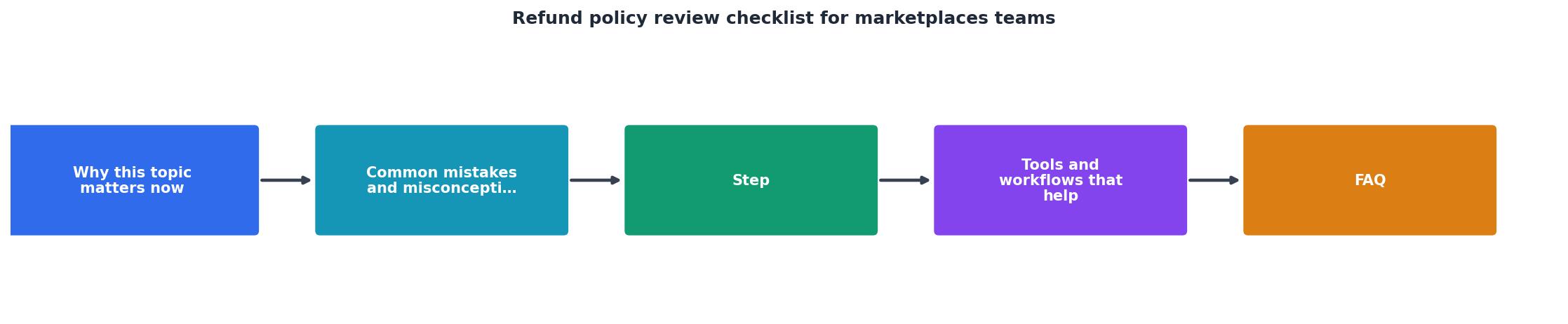
Step-by-step review process

"The following is a checklist to help you ensure your submission and review go smoothly.">, Microsoft 365 app publishing checklist
Follow this process to align your policy with your business, legal requirements, and user expectations:
Phase 1: Gather information
- Product team: Inventory all product types, delivery methods, and refund triggers.
- Customer support: Review past refund requests, complaints, and patterns.
- Finance: Model the financial impact of different refund windows and rates.
- Legal/compliance: Identify applicable regulations (GDPR, FTC, consumer protection laws, payment processor rules).
Phase 2: Draft and document
- Write the policy in plain language, avoiding legal jargon where possible.
- Create flowcharts or decision trees for common refund scenarios.
- Link the policy clearly from your marketplace homepage, checkout page, and seller center.
- Translate it into major languages if your marketplace is international.
Phase 3: Internal review
- Legal review: Confirm compliance with regulations and payment processor terms.
- Product review: Ensure the policy aligns with your actual refund system and tooling.
- Customer support review: Validate that the policy is easy to explain and enforce.
- Finance review: Confirm refund rates and timelines are sustainable.
Phase 4: Test with real scenarios
- Document 5–10 common refund scenarios (e.g., partial delivery, buyer error, seller non-response).
- Simulate the refund process from request to resolution for each.
- Identify friction points and clarify the policy accordingly.
Phase 5: Launch and communicate
- Publish the policy prominently and require buyer/seller acknowledgment.
- Train your support team on policy interpretation and enforcement.
- Monitor refund requests and policy disputes for 4–6 weeks post-launch.
- Adjust the policy based on real-world feedback.
The refund policy checklist
Refund Policy Review Checklist for Marketplaces
Your progress is saved automatically in your browser.
Red flags to watch for
As you review your policy, look for these common pitfalls:
- Contradictions: Policy says "30 days" in one place and "14 days" in another.
- Vague language: "Reasonable time," "fair reason," "at our discretion", these invite disputes.
- Hidden restrictions: Burying refund limits in footnotes or hidden behind a click.
- Automatic denial: Refusing all refunds for digital products without exception can violate consumer law in some regions.
- No escalation path: Support-team-only decisions can seem arbitrary; include an appeal process.
- Auto-renewal surprise: Refund policy silent on cancellation rights for subscriptions (a red flag for Terms Doctor's 101 checks).
- Seller loopholes: Allowing sellers to override your marketplace refund policy without clear limits.
Integrating refund policy with Terms Doctor
Automated compliance tools can help you stay on top of policy changes and regulatory updates. Terms Doctor scans your terms of service and refund policy against 101 consumer-protection checks, flagging:
- Forced arbitration clauses that restrict refund disputes.
- Auto-renewal terms that obscure refund or cancellation rights.
- Data retention policies that may conflict with refund-request privacy.
- Indemnity clauses that shift refund liability unfairly.
FAQ
Frequently Asked Questions
Get started with a stronger refund policy
A fair, transparent refund policy is an investment in trust and compliance. Use the checklist above to audit your current policy, involve your legal, product, customer support, and finance teams, and test your policy against real-world scenarios before launch.
Ready to audit your entire terms of service and refund policy? Download the free Terms Doctor browser extension to scan your marketplace or vendor terms against 101 consumer-protection checks. Get an A–F grade, see which clauses need revision, and track policy changes over time. It takes minutes and requires no legal background. Check it out today and give your buyers the confidence they deserve.
Remember: automated compliance checks are not legal advice. Always have a lawyer review major policy changes, especially if you operate across multiple countries.
Quick Refund Policy Summary
A well-crafted refund policy should clearly define:
- Refund window: Specific number of days with clear start date
- Refundable scenarios: Full, partial, or store credit options
- Non-refundable scenarios: Digital products after download, customized goods, or breach situations
- Refund method and timeline: How and when customers receive their money
- Dispute process: Clear steps for appeals and escalations
Use the checklist provided in this guide to ensure your refund policy covers all essential elements and protects both your marketplace and your customers.
Additional Resources
- Microsoft 365 app publishing checklist - Marketplace ... - Use this checklist to determine if your Microsoft 365 app is ready to be published.
- Refund policy for Microsoft Marketplace - You're eligible for a full refund, excluding metered billing charges, if you cancel your SaaS subscription within 72 hours of purchase.
- How to Manage Returns in a Marketplace: A Practical Guide ... - Learn how to manage returns in a marketplace with clear policies, automation tools, and strategies to reduce refunds and recover value.
Ready to Read Terms Before You Sign?
Terms Doctor finds terms of service on any site and grades them A-F in seconds.
Get Started“Terms Doctor flagged forced arbitration and AI training clauses in seconds. I finally know what I am agreeing to.”
Privacy-conscious shopper