Privacy policy review checklist for marketplaces teams
Running a marketplace, whether for services, products, or digital goods, means holding buyer and seller data at scale. Your privacy policy isn't just a legal checkbox; it's the contract that tells users what you'll do with their information, and it directly affects their trust in your platform. Marketplace teams often juggle compliance (GDPR, CCPA, and emerging rules), vendor expectations, and internal security practices. Without a clear review process, gaps slip through, exposing your company t

Photo by Mikhail Nilov from Pexels
Running a marketplace, whether for services, products, or digital goods, means holding buyer and seller data at scale. Your privacy policy isn't just a legal checkbox; it's the contract that tells users what you'll do with their information, and it directly affects their trust in your platform. Marketplace teams often juggle compliance (GDPR, CCPA, and emerging rules), vendor expectations, and internal security practices. Without a clear review process, gaps slip through, exposing your company to regulatory fines, customer churn, and reputational damage.
This checklist walks your team through a structured privacy policy review so you catch the gaps that matter, forced arbitration, vendor data sharing, hidden AI training, auto-renewal traps, and more, before they become liabilities.
TL;DR- Privacy policies for marketplaces must disclose how you collect, store, and share user data across buyers, sellers, and third parties.
- Legal bases for data collection (consent, contract, legitimate interest) must be explicit and justified under GDPR, CCPA, and comparable laws.
- Vendor integrations, payment processors, and analytics tools create new data-sharing touchpoints that require disclosure and user control.
- Auto-renewal, forced arbitration, and unilateral amendment clauses are red flags that erode user trust and may violate consumer protection laws.
- A structured review process, with cross-functional ownership, prevents compliance drift and keeps your policy aligned with platform changes.
Why marketplace privacy policies need special care

Marketplaces handle more types of user data than typical SaaS products. Buyers share payment methods, addresses, and browsing history. Sellers submit tax IDs, business licenses, and bank account details. Your platform then passes subsets of that data to payment processors, delivery partners, customer support tools, and analytics vendors. Each handoff introduces a compliance obligation.
Add regulatory complexity on top: GDPR applies if you serve EU residents; CCPA and CPRA govern California users; UK GDPR, Brazil's LGPD, and India's upcoming laws are catching up. Each law defines "personal data," "processing," and "legitimate interest" differently. A privacy policy that works in the US may not pass GDPR scrutiny in Europe.
Key takeaway: Marketplace privacy policies must name every third party you share data with, explain the legal basis for each collection, and give users meaningful control, or risk fines up to 4% of global revenue (GDPR) or class-action liability.
Assemble your review team
Before you dive into the checklist, assign clear ownership. Privacy policy reviews are not a solo legal task, they require input from product, engineering, compliance, and operations.
Who should be in the room?
- Legal / Compliance lead, Interprets regulations, flags legal exposure, and signs off on final language.
- Product manager, Explains current and planned features (e.g., new data collection, third-party integrations).
- Engineering lead, Knows what data is actually collected, how it flows, and what systems touch it.
- Operations / Vendor manager, Lists all third-party vendors and what data they receive.
- Customer support lead, Shares what privacy and data-handling questions users ask most.
The privacy policy review checklist

Use this structured checklist to audit your current privacy policy. Go through each section with your team, mark off items as you verify them, and flag gaps for remediation.
Data collection & legal bases
Data Collection & Legal Bases
Your progress is saved automatically in your browser.
Third-party data sharing
"The GDPR, for instance, lists out the following as acceptable legal bases for collection:.">, The Ultimate Privacy Policy Checklist
A marketplace shares data with vendors constantly. Your policy must name them and explain why.
Third-Party Data Sharing
Your progress is saved automatically in your browser.
User rights & controls
User Rights & Controls
Your progress is saved automatically in your browser.
Marketplace-specific risks

Marketplaces face unique compliance challenges because they sit between two user groups and manage transaction data that touches payments, dispute resolution, and tax reporting.
Marketplace-Specific Risks
Your progress is saved automatically in your browser.
Step-by-step review process
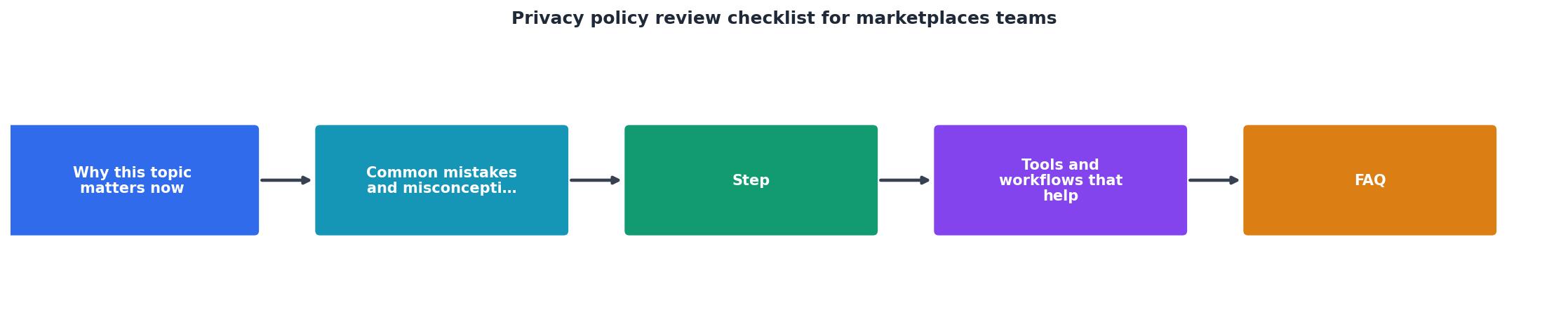
A one-time checklist audit isn't enough; privacy policies drift as your product evolves. Establish a repeatable process:
1. Trigger review quarterly or when material changes occur
Set calendar reminders for Q1, Q2, Q3, Q4. Also trigger an immediate review if you:- Add a new data source (e.g., behavior tracking, AI profiling).
- Integrate a new vendor or third-party tool.
- Expand to a new country or jurisdiction.
- Change your data retention, deletion, or sharing practices.
- Launch a new product feature that touches user data.
2. Document current data flows
Before revising the policy, map what actually happens:- Create a vendor inventory: name, data received, legal relationship (processor or controller), country of storage.
- List all data categories: identifiers, commercial information, biometric data (e.g., payment fraud signals), internet activity.
- Document retention rules: when is buyer order history deleted, seller verification data purged, logs archived?
3. Run the checklist with your team
Assign one person to go through each section and gather evidence (e.g., DPAs, vendor agreements, code samples). Flag gaps.4. Draft updates & get legal sign-off
Prioritize gaps by risk (regulatory exposure, user harm). Draft updates in plain language, then have legal review for compliance. Use Terms Doctor to spot red flags: forced arbitration, hidden auto-renewal, unilateral amendment language.5. Publish & notify users
In many jurisdictions (GDPR, CCPA, many state laws), you must notify users of "material changes." Publish your updated policy and send an email explaining what changed. Archive the old version so users can compare.6. Track version history
Maintain a changelog: version number, date, and a one-sentence summary of each change. This helps users and regulators understand your evolution and proves you're transparent about updates.Common privacy policy mistakes to avoid
Even well-intentioned teams slip into compliance traps. Here are the most frequent:
- Vague vendor disclosures
- ❌ Bad: "We use third-party services to improve your experience."
- ✅ Good: "We use Segment (a data analytics platform) to track feature usage and crashes. Segment is a processor under GDPR and stores data in the US under Standard Contractual Clauses."
- Burying auto-renewal and forced arbitration
- ❌ Bad: Arbitration clause tucked in fine print at the end of a 50-page terms document.
- ✅ Good: Separate "Arbitration & Dispute Resolution" section in both ToS and privacy policy; a checkbox confirming the user understands they're giving up the right to sue in court.
- Overstating data deletion
- ❌ Bad: "All data is deleted within 30 days."
- ✅ Good: "Buyer purchase history is retained for 7 years for tax and fraud investigation; you can request deletion after 3 years via your account settings. Backup copies may take up to 90 days to purge."
- Ignoring consent withdrawal
- ❌ Bad: Policy lists GDPR rights but offers no way to withdraw consent or opt out of marketing.
- ✅ Good: Every email includes an unsubscribe link; account settings offer granular privacy controls; opt-out requests are processed within 10 days.
- Not disclosing AI training or use
- ❌ Bad: Policy is silent on whether buyer data or seller reviews train recommendation algorithms.
- ✅ Good: "We use buyer purchase patterns to generate personalized recommendations. We do not train external AI models on your data. You can opt out of personalization in your privacy settings."
- Failing to update for new vendors
- ❌ Bad: Policy lists vendors from 2 years ago; you've added Mixpanel, Braze, and DataBox since then.
- ✅ Good: Vendor list is reviewed and updated every quarter; policy version reflects the publication date.
Using Terms Doctor to audit your privacy policy
Terms Doctor automatically scans marketplace privacy policies for 101 consumer-protection issues, including:- Forced arbitration clauses that block class actions or court access.
- Auto-renewal traps that make cancellation hard.
- Unilateral amendment clauses that let you change terms without user consent.
- Data sharing for AI training or third-party marketing without opt-in.
- Dark patterns in consent or opt-out flows.
Frequently Asked Questions
Next steps: Make privacy policy review a habit
Key takeaway: A privacy policy is a living document, not a set-it-and-forget-it legal artifact. Assign clear ownership, review at least quarterly, and update whenever your product or vendor landscape shifts.
Start with the checklist above: gather your cross-functional team, run through each section, and flag gaps. Prioritize by regulatory risk (GDPR exposure, CCPA liability) and user impact (arbitration, data sharing, auto-renewal). Then update your policy in plain language, get legal sign-off, and notify users of material changes.
If you're unsure whether your privacy policy or terms of service hold up to scrutiny, try Terms Doctor, the free Chrome, Edge, Brave, Opera, and Vivaldi extension that automatically discovers your marketplace's ToS and privacy policy, runs 101 consumer-protection checks, and grades them A–F. You'll spot forced arbitration, hidden auto-renewal, unilateral amendment clauses, and data-sharing red flags in seconds. Use the report to guide your team's review and demonstrate compliance to internal stakeholders and regulators.
Note: This guide is not legal advice. Consult a privacy attorney licensed in your jurisdiction before publishing any changes to your policy.
Additional Resources
- The Ultimate Privacy Policy Checklist - 1. Your business and contact information · 2. The categories of data you collect · 3. The sources of the data or how you collect data · 4. The ...
- Privacy Policy Requirements Checklist for Websites & Apps - Our privacy policy requirements checklist outlines the steps to ensure your privacy policy is legal and compliant with global privacy laws.
- Marketing Guide: Creating a Website Privacy Policy Checklist - 1. Conduct a Privacy Audit. · 2. Develop or Review Privacy Policies. · 3. Cookie Management and Consent. · 4. Implementing Data Protection Measures ...
Ready to Read Terms Before You Sign?
Terms Doctor finds terms of service on any site and grades them A-F in seconds.
Get Started“Terms Doctor flagged forced arbitration and AI training clauses in seconds. I finally know what I am agreeing to.”
Privacy-conscious shopper