
Photo by SiljeAO - from Pexels
Every time you sell on a marketplace, or buy from one, a Data Processing Agreement (DPA) quietly governs what happens to your personal information behind the scenes. Most sellers never read it. Most buyers don't even know it exists. Yet a weak or missing DPA can mean your customer data gets shared with ad networks, used for AI model training, or retained long after you close your account.
In this guide we break down what a marketplace DPA should contain, which clauses Terms Doctor flags first during its automated scan, and how you can protect yourself in under five minutes, no lawyer required.
TL;DR
- A DPA defines who controls your data and who merely processes it on a marketplace platform.
- Marketplaces often bury broad data-sharing rights, unlimited retention periods, and weak breach-notification language inside their DPAs.
- Terms Doctor's 101 consumer-protection checks automatically surface the riskiest DPA clauses and assign an A-F grade.
- You should look for sub-processor transparency, data deletion timelines, and clear breach-notification windows before committing to any marketplace.
- Automated checks are a starting point, they are not legal advice.
What is a DPA and why do marketplaces need one?

A Data Processing Agreement is a legally binding contract between a data controller (the party that decides why and how personal data is collected) and a data processor (the party that handles the data on the controller's behalf). Under the GDPR, the ePrivacy Directive, and similar laws worldwide, this agreement is mandatory whenever personal data changes hands.
On a marketplace the relationship gets complicated fast. Consider a platform like Etsy, Amazon Marketplace, or Fiverr:
- The seller collects buyer names, addresses, and payment details to fulfil orders.
- The marketplace processes that data to run the storefront, handle payments, and serve ads.
- Third-party logistics or payment providers may act as sub-processors.
Controller vs. processor: the marketplace twist
Many marketplaces claim the role of independent controller rather than processor. That single word change means the platform can use buyer data for its own purposes, targeted ads, product recommendations, even AI training, without needing the seller's explicit permission. Terms Doctor flags this distinction automatically because it dramatically shifts the risk profile for anyone doing business on the platform.
The five DPA clauses Terms Doctor flags first

When you visit a marketplace's terms page and activate Terms Doctor, the extension runs its full suite of checks in seconds. Here are the five DPA-related issues that rise to the top of the report most often:
- Broad data-sharing with unnamed sub-processors. A DPA that says "we may share data with our partners" without listing those partners or providing an up-to-date sub-processor list is a red flag. GDPR Article 28 requires the processor to inform the controller about any new sub-processors and give them a chance to object.
- No defined data-retention period. If the DPA says data is kept "as long as necessary" without specifying a concrete timeframe or deletion trigger, your customers' information could sit on marketplace servers indefinitely, even after you delete your seller account.
- Weak or missing breach-notification window. The GDPR mandates that processors notify controllers of a data breach "without undue delay." Many marketplace DPAs either omit a specific hour window or stretch it to 72 hours for the processor's internal assessment alone, leaving the controller with almost no time to notify affected individuals.
- AI training or analytics clauses. A growing number of platforms include language allowing them to use transaction data, reviews, or even private messages for machine-learning purposes. Terms Doctor specifically checks for AI-training-on-user-data clauses and highlights them with a red-flag icon.
- Unilateral amendment rights. Some marketplaces reserve the right to change the DPA at any time by simply posting an update on their website. Without a notification mechanism or a grace period, sellers can find themselves bound by materially different terms overnight.
Key takeaway: A marketplace DPA that is vague about sub-processors, retention, breach notification, AI usage, or amendment rights should be treated as high-risk until proven otherwise.
How Terms Doctor scans a marketplace DPA: step by step
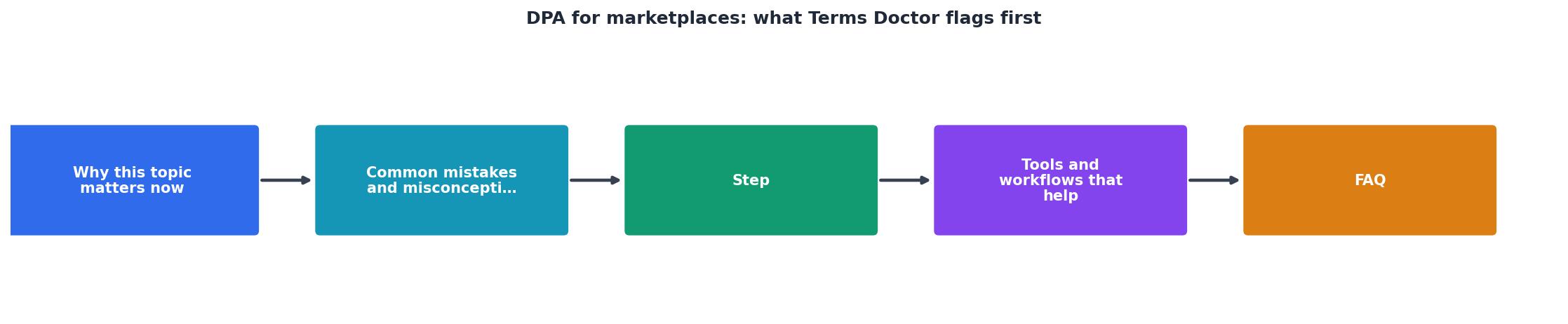
Here is exactly what happens when you land on a marketplace's legal page with the extension installed:
- Automatic ToS discovery. Terms Doctor detects the terms-of-service or DPA page without you having to copy-paste anything. It works on Chrome, Edge, Brave, Opera, and Vivaldi.
- Clause extraction. The extension parses the document into individual clauses and maps each one to its relevant consumer-protection category (data sharing, retention, arbitration, auto-renewal, and so on).
- 101-check analysis. Every clause is evaluated against 101 predefined consumer-protection checks. Checks related to DPA provisions, sub-processor lists, breach windows, data deletion, are weighted heavily for marketplace pages.
- A-F grading. The overall document receives a letter grade from A (very consumer-friendly) to F (significant red flags). Each flagged clause gets a plain-language explanation so you understand the risk without decoding legal jargon.
- Red-flag highlights. The most critical issues appear at the top of the report with red icons. You can click any flag to jump directly to the relevant paragraph in the original document.
- Change tracking. If you revisit the same marketplace later, Terms Doctor compares the current version of the DPA with the one it stored previously and alerts you to any modifications, especially useful for catching those unilateral amendment clauses mentioned above.
Your DPA review checklist

Use this checklist every time you evaluate a new marketplace. You can run through it manually or let Terms Doctor handle the heavy lifting automatically.
Marketplace DPA Review Checklist
Your progress is saved automatically in your browser.
Red flags vs. green flags: a quick comparison
Not every DPA clause is bad. Here is a side-by-side look at what healthy language looks like compared with the problematic versions Terms Doctor highlights:
| Area | 🟢 Green flag | 🔴 Red flag |
|---|---|---|
| Sub-processors | Named list updated quarterly with 30-day objection window | "We may engage third parties at our discretion" |
| Retention | "Data deleted within 30 days of account closure" | "Data retained as long as commercially necessary" |
| Breach notification | "Controller notified within 24 hours of confirmed breach" | "Notification provided in a reasonable timeframe" |
| AI / analytics | "Transaction data is not used for model training" | "We may use aggregated and individual data to improve our services, including machine-learning features" |
| Amendments | "30-day notice via email before changes take effect" | "Continued use constitutes acceptance of updated terms" |
Real-world scenarios where a weak DPA hurts
Understanding theory is one thing; seeing the consequences is another. Here are three situations where a poor marketplace DPA directly impacts you:
Scenario 1: The silent sub-processor swap
You sell handmade goods on a marketplace that routes payments through Stripe. One day the platform quietly switches to a lesser-known payment processor based in a jurisdiction with weaker data-protection laws. Because the DPA had no sub-processor notification clause, you only find out when a customer complains about unfamiliar charges on their statement. With Terms Doctor's change-tracking feature, you would have been alerted the moment the terms page was updated.
Scenario 2: Post-account-deletion data retention
A freelancer closes their marketplace account after moving to direct client work. Two years later, a data breach at the marketplace exposes old client invoices, including names, email addresses, and project descriptions. The DPA allowed "indefinite retention for compliance purposes" without specifying which compliance obligation justified it. A concrete retention limit, flagged as missing by Terms Doctor, would have forced the platform to purge that data.
Scenario 3: AI training on private messages
A buyer discovers that the marketplace's updated DPA now permits using private messages between buyers and sellers to train a recommendation engine. The amendment clause allowed changes without direct notification. Terms Doctor's red-flag check for AI-training-on-user-data would have surfaced this clause immediately, and change tracking would have highlighted the new language the moment it appeared.
FAQ
Frequently Asked Questions
Protect yourself in five minutes
You do not need a legal degree to spot a dangerous marketplace DPA. Install the free Terms Doctor extension for Chrome, Edge, Brave, Opera, or Vivaldi, visit any marketplace's terms page, and let the 101 automated checks do the reading for you. The A-F grade and red-flag highlights give you a clear, actionable summary, so you can make informed decisions before handing over your data or your customers' data. Remember: automated checks are a effective first step, but they are not a substitute for professional legal advice when the stakes are high.
Additional Resources
- DPA Crash Course—What Is It and Why It's Getting Bigger - Find out Dan's five strategic tips everyone should know about catalog ads and why DPA is growing rapidly. When should we NOT use DPA? Does DPA ...
- How Offering DPA Programs Can Set You Apart - Set yourself apart from the competition by being proactive, not reactionary. Offer DPA programs that help put buyers in the driver's seat.
- Definition of DPA - NCI Dictionary of Cancer Terms - A legal document that gives one person (such as a spouse, relative, friend, or lawyer) the authority to make medical, legal, or financial decisions for another ...