
Photo by Erik Mclean from Pexels
You signed up for a shiny new SaaS tool last week. You uploaded client files, pasted meeting notes, and maybe even connected your calendar. Somewhere in the privacy policy you skimmed, or skipped, was a clause granting the vendor the right to feed every byte of that data into its AI models. If that thought makes your stomach drop, you are not alone, and this article will show you exactly what to look for before it is too late.
TL;DR
- Many SaaS privacy policies now include broad clauses that allow vendors to use your content, prompts, uploads, metadata, to train machine-learning models.
- Red-flag language often hides behind vague terms like "service improvement," "aggregated data," and "de-identified information."
- Opting out is rarely the default; you usually have to dig through account settings or email support.
- A single overlooked AI-training clause can expose trade secrets, violate client NDAs, and trigger compliance issues under GDPR or CCPA.
- Tools like the free Terms Doctor extension can surface these clauses automatically so you do not have to read every word yourself.
Why AI training clauses are spreading across SaaS

The generative-AI gold rush has changed the economics of SaaS. Training a large language model from scratch costs millions, but fine-tuning one on real customer data is comparatively cheap, and the resulting model is far more useful for the vendor's product roadmap. That creates a effective incentive: the more user data a company can funnel into its training pipeline, the better its AI features become, and the wider the competitive moat grows.
For vendors, the easiest way to secure that data pipeline is a single paragraph buried deep in a privacy policy. Because most users never read past the cookie banner, the clause goes unchallenged. The result is a quiet but massive transfer of value: your content improves the vendor's product, and you receive nothing in return, except risk.
"The 2025 SaaS Management Index found that 46% of SaaS apps in a typical portfolio carry a 'Poor' or 'Low' risk score, showing just how widespread risky apps proliferate.">, The Dark Side of AI: Data Security Threats & How to Prevent Them
This is not a niche problem. Nearly half the tools in an average company's stack already carry elevated risk scores, and AI-training clauses are one of the fastest-growing contributors to those scores.
The 7 biggest red flags in AI-training privacy language

Not every mention of AI in a privacy policy is dangerous, but certain phrases should make you pause and investigate further. Here are the seven warning signs that matter most:
- "We may use your content to improve our services." This is the classic catch-all. "Improve our services" can mean anything from fixing bugs to training a foundation model on your proprietary data. If the policy does not explicitly exclude AI or machine-learning training from "improvement," assume it is included.
- "Aggregated or de-identified data." Vendors often claim they only train on data that has been stripped of personal identifiers. The problem is that "de-identified" has no single legal definition, and research has repeatedly shown that supposedly anonymous datasets can be re-identified. If the policy does not describe the de-identification method or reference a recognized standard, the promise is hollow.
- "You grant us a worldwide, royalty-free, perpetual license." This language gives the vendor an irrevocable right to use your content forever, even after you cancel your subscription. A perpetual license paired with an AI-training clause means your data could live inside a model long after you have deleted your account.
- "Inputs and outputs." Some AI-powered tools claim rights not only to what you type in (prompts, uploads) but also to what the tool generates for you. That means the vendor can re-use AI-generated reports, summaries, or code that you paid for.
- "Third-party model providers." If the vendor sends your data to an external AI provider, OpenAI, Anthropic, Google, or others, your content is now subject to two privacy policies, not one. Check whether the sub-processor's terms also permit training.
- "Opt-out available upon request." An opt-out that requires you to email support or toggle a hidden setting is not a real default. If training is on by default and the opt-out is buried, most users will never exercise it.
- "We may update this policy at any time." A unilateral amendment clause means the vendor can add AI-training rights tomorrow without asking you. If the policy does not promise advance notice or require your consent for material changes, today's safe terms could become tomorrow's red flag.
How to audit a SaaS privacy policy step by step
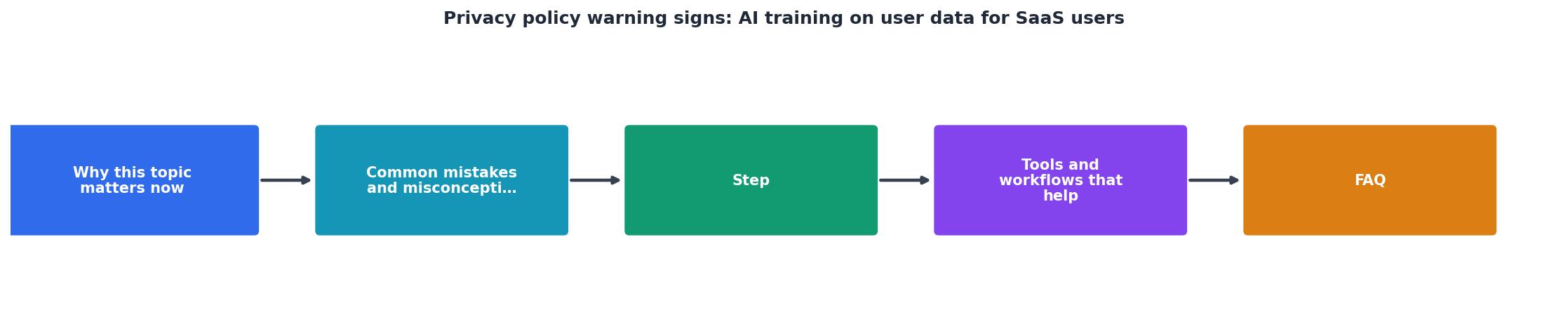
You do not need a law degree to spot the worst clauses. Follow this process every time you evaluate a new tool, or re-evaluate one you already use.
Step 1: Find the actual privacy policy
Many SaaS sites have both a "Privacy Policy" and a "Terms of Service." AI-training language can appear in either document, or in a separate "AI Addendum" or "Data Processing Agreement." Collect all of them before you start reading.
Step 2: Search for AI-specific keywords
Use your browser's find function (Ctrl+F) and search for: "train," "machine learning," "artificial intelligence," "model," "improve," "aggregate," "de-identify," "input," "output," "content license." Each hit is a paragraph worth reading carefully.
Step 3: Map the data flow
Ask three questions for every clause you find: What data is collected? (uploads, prompts, metadata, usage logs) Where does it go? (vendor servers, third-party model providers, "affiliates") How long is it kept? (session only, account lifetime, perpetual). If the policy does not answer all three, that silence is itself a red flag.
Step 4: Check the opt-out mechanism
Look for an opt-out toggle in your account settings. If none exists, search the help center or email support. Document the response, you may need it for compliance audits later.
Step 5: Automate ongoing monitoring
Privacy policies change. A clause that was safe six months ago may have been quietly rewritten. Use a tool that tracks policy changes over time so you are alerted when new AI-training language appears.
Real-world consequences of ignoring AI-training clauses

Overlooking an AI-training clause is not just a theoretical risk. Here are concrete scenarios that play out regularly:
- Trade-secret leakage. A freelance designer uploads client brand guidelines to an AI-powered design tool. The tool's policy permits training on user uploads. Months later, a competitor using the same tool receives suspiciously similar design suggestions. The original client's trade secrets have effectively been laundered through a model.
- NDA violations. A consultant pastes confidential meeting notes into an AI summarizer. The summarizer's vendor shares data with a third-party model provider whose terms also allow training. The consultant has now breached the NDA with their client, possibly without even realizing it.
- Loss of intellectual property. A perpetual, royalty-free content license means the vendor can continue using your data even after you leave the platform. If your content ends up embedded in model weights, there is no practical way to "delete" it.
Your privacy-policy audit checklist
Use this checklist every time you sign up for a new SaaS tool or when an existing vendor notifies you of a policy update.
SaaS Privacy Policy AI-Training Audit
Your progress is saved automatically in your browser.
How Terms Doctor helps you stay ahead
Manually auditing every SaaS privacy policy is possible but exhausting, especially when the average business uses dozens of tools. Terms Doctor was built to close that gap. The free browser extension for Chrome, Edge, Brave, Opera, and Vivaldi automatically finds the terms of service on any website you visit, runs 101 consumer-protection checks (including specific detection of AI-training-on-user-data clauses, forced arbitration, auto-renewal traps, and more), and presents the results as a simple A-F grade with plain-language explanations. You can review red-flag highlights in seconds instead of spending thirty minutes with Ctrl+F. If you manage a portfolio of SaaS subscriptions, the change-tracking feature alerts you when a vendor quietly updates its policy, so you are never caught off guard by a new AI-training clause that was not there last quarter.
FAQ
Frequently Asked Questions
Disclaimer: This article is for informational purposes only and does not constitute legal advice. Automated checks, including those provided by Terms Doctor, are not a substitute for professional legal counsel.
Additional Resources
- AI Companies: Uphold Your Privacy and Confidentiality ... - Model-as-a-service companies that fail to abide by their privacy commitments to their users and customers, may be liable under the laws enforced ...
- The Dark Side of AI: Data Security Threats & How to ... - AI tools often operate in gray areas regarding user consent and data visibility. When sensitive inputs are processed without disclosure or ...
- Be Careful What You Tell Your AI Chatbot | Stanford HAI - A Stanford study reveals that leading AI companies are pulling user conversations for training, highlighting privacy risks and a need for ...