
Photo by Namrata Singh from Pexels
You sign up for a project management tool. It works great for two weeks. Then you discover the company sold your project data to an AI training vendor without asking, and when you try to complain, the terms of service say you can't sue: you must go to binding arbitration instead. No court. No jury. No appeal.
This nightmare scenario happens more often than most SaaS users realize. Forced arbitration clauses hide in privacy policies and terms of service, quietly stripping away your right to legal recourse. If you use cloud tools for work or run a small business, understanding these warning signs isn't just smart, it's essential protection.
TL;DR
- Forced arbitration is a clause that forces you to resolve disputes through a private arbitrator instead of court; it blocks you from suing, joining class actions, or appealing.
- Look for red-flag phrases like "binding arbitration," "waive the right to jury trial," "class action waiver," and "final and binding decision."
- Arbitration clauses often hide in privacy policies, not just Terms of Service, making them easy to miss during signup.
- Before signing up for any SaaS tool, search the ToS and privacy policy for arbitration language using
Ctrl+F(orCmd+F). - Terms Doctor's A-F grading system automatically flags forced arbitration and other consumer-protection red flags so you don't have to read 50 pages of legal text.
What is forced arbitration and why should you care?

Arbitration itself isn't inherently bad. It's a method of resolving disputes outside the court system, often faster and cheaper for both sides. But forced arbitration tips the scales dramatically in the company's favor.
When a SaaS vendor includes a forced arbitration clause, they're saying: "If we have a dispute, whether you sue us or we sue you, neither of us can go to court. Instead, we both must hire a private arbitrator to decide the case. And that decision is final; you can't appeal it."
Here's why this matters:
You lose your day in court. Court systems are designed with consumer protections: judges follow strict rules of evidence, juries can award punitive damages (meant to punish bad behavior), and you have the right to appeal if you disagree with the verdict. Arbitration has none of these safeguards. A single arbitrator, often chosen from a list supplied by the company, makes a binding decision with almost no ability to challenge it.
Class actions become impossible. If the vendor's breach affects thousands of customers (like selling user data to train AI models without consent), a class action lawsuit can hold them accountable and compensate everyone. Forced arbitration typically includes a "class action waiver," which means each customer must arbitrate individually. This makes it economically impossible for most people to pursue justice: hiring an arbitrator costs $5,000–$20,000 upfront, money most individuals can't afford. The company knows this. They're betting you'll give up.
Arbitrators favor repeat customers. Arbitration companies, like JAMS or the American Arbitration Association, depend on repeat business. SaaS vendors and large corporations use arbitration constantly; individual consumers rarely do. Arbitrators, consciously or not, may lean toward the side that brings them future business.
Your evidence stays private. Court cases are public; arbitration is confidential. When a vendor's practices harm you, others never learn about it. This lets companies repeat the same harmful behavior without public scrutiny.
Key takeaway: Forced arbitration isn't a neutral alternative to court, it's a legal mechanism that systematically favors corporations over consumers by eliminating transparency, appeal rights, and the economic viability of class action justice.
Red-flag language in privacy policies and terms of service

Forced arbitration clauses don't always use the phrase "forced arbitration." Companies bury them under dense legal language, split them across multiple pages, or hide them in appendices. Here are the exact phrases that should make you pause:
Direct red flags
- "Binding arbitration", The decision is final and cannot be appealed.
- "You agree to arbitrate", Confirms you're waiving your right to court.
- "Waive the right to jury trial", No jury will hear your case.
- "Class action waiver", You cannot join or start a class action lawsuit.
- "Individual, bilateral arbitration", Only you and the company can arbitrate; no group claims allowed.
- "Final and binding decision", There's no appeal process; the arbitrator's decision stands forever.
- "Governing law and dispute resolution", The section heading that often precedes arbitration language.
Indirect red flags
- "American Arbitration Association (AAA)" or "JAMS", Names of arbitration companies; their mention suggests the clause is coming.
- "Waive any right to a trial", Generic waiver that may include arbitration.
- "All disputes shall be resolved by [arbitration/mediation]", Broad language forcing all disagreements into arbitration.
- "Injunctive relief only in court", Sneaky language: it says disputes go to arbitration, except the company can sue you in court for urgent matters (like an injunction to stop you from leaking trade secrets).
Where arbitration clauses hide: a practical guide
Companies aren't always obvious about where they place arbitration language. Here's where to look:
1. Terms of Service, "Dispute Resolution" or "Governing Law" section
This is the most common location. Scroll to the bottom of the ToS; you'll usually find a section titled "Dispute Resolution," "Governing Law," "Arbitration," or "Legal." This section typically also specifies which state's laws apply to the contract.
2. Privacy Policy, "Limitation of Liability" or "Miscellaneous"
Many companies split dispute-resolution clauses across multiple documents. The privacy policy might say "we do not guarantee accuracy of data" or "we limit our liability," and then reference the Terms of Service for dispute mechanics. Always cross-reference.
3. Separate Arbitration Addendum or Exhibit
Some vendors attach a standalone arbitration agreement as an exhibit (Exhibit A, Schedule 1, etc.). You might miss it if you only skim the main ToS. Look for links or references to additional documents at the start or end of the ToS.
4. "Supplemental Terms" or "Service-Specific Terms"
If the vendor offers multiple products or services (e.g., free tier and paid tier, or analytics plus automation), they may use separate terms for each. Arbitration clauses can differ between them.
5. In the signup flow, buried in checkboxes
Some vendors don't clearly display the full ToS during signup. They may show a checkbox that says "I agree to the Terms of Service" with a tiny link. The full ToS, including arbitration language, is hidden behind that link.
Top tip: Before clicking "I agree," open the ToS in a new tab and search for "arbitration," "binding," "waive," and "class action" using Ctrl+F (Windows) or Cmd+F (Mac). Spend 60 seconds on this search. It could save you thousands in legal fees later.
How to spot arbitration clauses: step-by-step checklist
Pre-Signup Privacy & ToS Review Checklist
Your progress is saved automatically in your browser.
The real-world impact: why this matters more than ever
"The original intent was to create an efficient way for businesses with comparable bargaining power to negotiate and agree upon an alternate means of conflict resolution.">, Stop Forced Arbitration in Data Privacy Legislation
That quote captures the problem. Arbitration was designed for disputes between two businesses of equal size negotiating a contract. It was never meant for a consumer clicking "I agree" to a 30-page document they didn't write and can't negotiate.
Consider a real-world scenario: You pay $29/month for a design SaaS tool. Six months in, you discover the vendor has been collecting your design files and feeding them into an AI model to train their own design generator. You want to sue for breach of privacy. But the ToS says disputes go to binding arbitration.
You have two options:
- Pay $10,000–$20,000 upfront to hire an arbitrator, hoping to recover your damages. Even if you win, you might only recover a few hundred dollars, far less than the arbitration fees. Financially, it makes no sense.
- Give up and move to a different tool, knowing the vendor will never face consequences. They do the same thing to the next 10,000 customers.
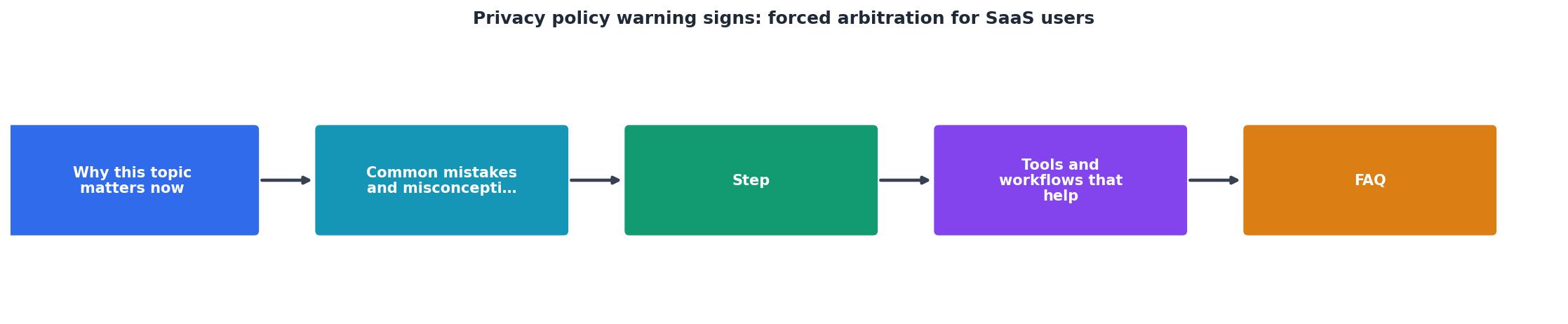
How Terms Doctor helps you spot these clauses instantly
Manually reviewing every ToS is exhausting, and most people skip it entirely. That's where Terms Doctor comes in.
Terms Doctor runs 101 consumer-protection checks on any website's privacy policy and terms of service, including automated detection of forced arbitration clauses. When you visit a SaaS vendor's site with the Terms Doctor extension installed, it:
- Automatically discovers the ToS and privacy policy (you don't have to hunt for them).
- Grades the terms A through F in plain language.
- Highlights arbitration clauses, class action waivers, and other red flags in red.
- Explains each issue in simple terms so you understand what you're signing.
What to do if you find forced arbitration
If you discover a forced arbitration clause and still want to use the service, here are your options:
1. Negotiate (if you're a business customer)
If you're signing a high-value contract, you may have leverage. Many companies will remove or modify arbitration language if you ask. A single-clause removal might save you $50,000+ in future legal costs. Reach out to sales and make it a condition of your deal.
2. Accept the risk consciously
You're not obligated to avoid the service. Just go in with eyes open: know what rights you've waived and budget accordingly. This is most reasonable for low-cost tools where the stakes are lower.
3. Look for alternatives
Many vendors compete on terms, not just features. Search for competitors and compare their ToS using Terms Doctor. You might find a tool with similar features but without forced arbitration.
4. Support legislative change
The Stop Forced Arbitration in Consumer Contracts Bill (which became law in 2023 for certain sectors) limits forced arbitration in specific industries. Advocacy groups like the Electronic Frontier Foundation (EFF) continue pushing for broader protections. Supporting these efforts helps long-term.
5. Document your acceptance
If you do use a service with forced arbitration, keep records of when you signed, which version you saw, and what you understood. If a dispute arises later, these details matter in arbitration.
Key Takeaway
Forced arbitration clauses systematically disadvantage consumers by eliminating transparent court proceedings, removing the right to appeal, and making class action justice economically impossible. Before signing up for any SaaS tool, always search the Terms of Service and Privacy Policy for arbitration language. Terms Doctor automates this process, scanning for arbitration clauses and 100 other consumer-protection risks so you can make informed decisions about which services to trust with your data and business.
FAQ
Frequently Asked Questions
Protect yourself: download Terms Doctor today
Reviewing every privacy policy and terms of service before signing up is the smart choice, but most of us don't have time. Terms Doctor makes it instant. The free Chrome, Edge, Brave, Opera, and Vivaldi extension scans any website's terms in seconds, grades them A–F, and highlights red flags like forced arbitration, forced AI training on your data, auto-renewal traps, and 100 other consumer-protection issues.
You don't need a law degree to understand what you're signing. Let Terms Doctor do the heavy lifting, and sign up for services with confidence, or find a better alternative. Download the free extension today from termsdoctor.com and take back control of your digital privacy.
Note: This article is educational and not legal advice. If you're in an active dispute or need specific guidance about a contract, consult a qualified attorney in your jurisdiction.
Additional Resources
- Stop Forced Arbitration in Data Privacy Legislation - AT&T violated the rights of their customers by disclosing their real-time location information without consent, in violation of state and ...
- SAAS User Agreement - Claims relating to this Agreement or the Service will be resolved through final and binding arbitration, except as set forth below. The parties agree that the ...
- SaaS Privacy Policy - ... binding arbitration. Further information can be found on the official DPF website: https://www.dataprivacyframework.gov/framework-article ...