

Photo by RDNE Stock project from Pexels
Marketplaces are everywhere. Whether you're buying handmade goods, hiring a freelancer, or selling your own products, you're entering into an agreement with the platform that hosts the transaction. But most marketplace terms of service are 50 pages long, buried in legal language, and almost never read before that first click of "I agree." That's a problem, because marketplaces hold enormous power over your account, your money, and your data.
The Terms Doctor extension was built to solve this. It scans any website's terms of service, runs 101 consumer-protection checks, and highlights the red flags that affect you most. For marketplace users, sellers, and freelancers, those flags matter. This article walks you through what Terms Doctor flags first when analyzing a marketplace's terms, and why each one matters.
TL;DR
- Forced arbitration clauses force disputes into private courts instead of real courts, and they almost always favor the platform.
- Auto-renewal traps bury renewal terms deep in the fine print to keep you paying without clear notice.
- AI training and data sharing clauses let marketplaces use your data (and seller data) to train AI models without explicit permission.
- Liability waivers prevent you from suing the marketplace even if it loses your money or exposes your personal information.
- Account termination without cause gives the platform the right to ban you and freeze your funds whenever it wants, for any reason.
Why marketplace terms matter more than you think

Marketplace terms are not like typical website privacy policies. They govern money, dispute resolution, seller liability, and your right to use the platform at all. When you list an item for sale, hire a contractor, or make a purchase, you're giving the marketplace control over:
- Payment processing and escrow: Your funds sit in the platform's account. Their terms decide when you get paid, what fees apply, and what happens if a dispute arises.
- Account suspension and termination: Most marketplaces reserve the right to ban you with little notice and no clear cause, and sometimes freeze your balance when they do.
- Dispute resolution: Instead of going to court, most marketplaces force you into arbitration or mandatory mediation, where the odds are stacked.
- Liability and damages: Marketplace terms often say they're not responsible even if they lose your data, expose your personal information, or fail to protect your account.
The five red flags Terms Doctor spots first
1. Forced arbitration clauses
Forced arbitration is the single most important red flag in any marketplace terms. Here's why: it strips you of your right to sue in court and forces disputes into private arbitration instead.
In arbitration, a private arbitrator (chosen and paid through a system controlled by the marketplace) makes a binding decision. You cannot appeal, there's no jury, and the process is usually secret. Most arbitration clauses also waive class actions, meaning you cannot join other users in a lawsuit even if the marketplace wronged thousands of you the same way.
The Terms Doctor checks for arbitration clauses and flags them immediately. A typical arbitration clause might read:
"The Parties agree that the only essential term to this Agreement is the agreement and willingness of both parties to arbitrate.">, Terms Of Service
This language makes it clear: arbitration is not optional. If you want to use the marketplace, you waive your right to court. And arbitration research shows that consumers lose far more often in arbitration than in court, often without even getting a hearing.
2. Auto-renewal and hidden subscription terms
Auto-renewal traps are designed to be confusing. A marketplace might offer a "free trial" for seller tools, premium shipping, or membership perks, but buried in the fine print is language that automatically converts you to a paid subscription after the trial ends.
Terms Doctor flags unclear auto-renewal language because it violates the spirit (and sometimes the letter) of the U.S. Restore Online Shoppers Confidence Act (ROSCA), which requires:
- Clear and conspicuous disclosure of all material terms before charging you
- Simple, easy-to-use cancellation
- Periodic reminders of your subscription status
3. AI training and data harvesting clauses
Increasingly, marketplace terms include language that lets them use your data and seller data to train AI models, often without explicit permission or compensation. They might say something like:
- "We may use your data and content to improve our services, including AI and machine learning."
- "You grant us a license to use content you upload for any purpose."
- "We may analyze your behavior and transactions to develop new features."
- Sellers' product photos and descriptions can be scraped to train image-generation and copywriting AI.
- Buyer reviews become training data for recommendation algorithms, often without the reviewer knowing.
- Your transaction history can be used to build predictive models about you and other customers.
4. Liability waivers and "as-is" disclaimers

Most marketplace terms include sweeping liability waivers that say things like:
- "The platform is provided 'as-is' without warranties of any kind."
- "We are not liable for lost data, unauthorized access, or transaction disputes."
- "We are not responsible for seller fraud, counterfeit items, or non-delivery."
Terms Doctor flags excessive liability disclaimers because they leave you with zero recourse if something goes wrong.
5. Account termination without cause

Many marketplace terms give the platform an unrestricted right to terminate your account "at any time, for any reason, with or without cause." This means:
- Your account can be banned without warning or explanation.
- Your balance can be frozen while the marketplace "investigates."
- You may have no appeal process and no way to retrieve your data or messages.
Terms Doctor flags "termination without cause" clauses because they give the marketplace unchecked power over your ability to use the platform, and your access to your own information.
How Terms Doctor analyzes marketplace terms: step-by-step
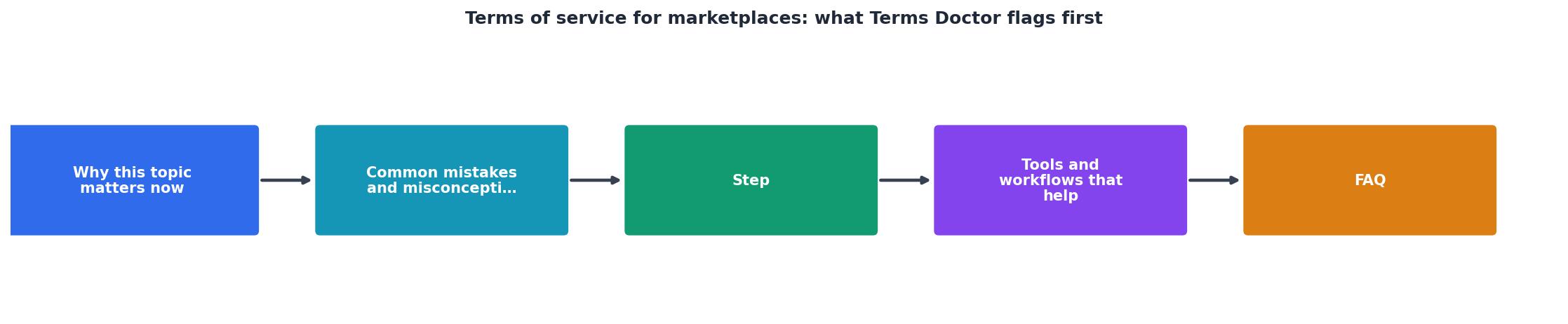
The extension works in three stages:
Stage 1: Discovery
When you visit any website, Terms Doctor automatically searches for links to the terms of service, privacy policy, and other legal pages. It finds them, even when they're hidden in the footer or buried behind a settings menu.Stage 2: Analysis
The Terms Doctor engine runs 101 checks against the terms. These checks scan for:- Forced arbitration and class-action waivers
- Auto-renewal traps
- Overly broad liability disclaimers
- Data-harvesting and AI-training clauses
- Account termination without cause
- Forced jurisdiction and governing law
- Unilateral modification rights
- And 94 more consumer-protection issues
Stage 3: Grading and highlighting
Terms Doctor assigns an A–F grade based on how consumer-friendly (or unfriendly) the terms are. It highlights the specific clauses that triggered red flags so you can read the exact language yourself, not a summary, not a lawyer's interpretation, just the actual words.Practical checklist: what to verify before you commit
Marketplace Terms Review Checklist
Your progress is saved automatically in your browser.
Why this matters: real-world marketplace disputes
When you sign up for a marketplace, you're betting that everything will go smoothly. But disputes happen. Here's how marketplace terms affect you when they do:
Scenario 1: You sell an item and the buyer disputes the charge.- If the terms require arbitration, you cannot sue the buyer in small claims court.
- You cannot ask a regular court to enforce the contract.
- You're stuck in the arbitrator's private process, paying arbitration fees, and the marketplace controls the outcome.
- If the terms allow termination without cause, the marketplace doesn't have to explain why.
- If the terms waive liability, you cannot sue them for wrongful termination.
- Your funds stay frozen while you wait for an appeal, if an appeal process even exists.
- If the terms include a broad liability waiver, the marketplace may not owe you damages.
- If the terms say they're not liable for "unauthorized access," they might argue the breach wasn't their fault.
- Without arbitration clauses to challenge, your only option is arbitration, not court.
How to use Terms Doctor to compare marketplace terms
- Install the free extension on Chrome, Edge, Brave, Opera, or Vivaldi from the Terms Doctor homepage.
- Visit the marketplace you're considering (or already use).
- Open the Terms Doctor popup and let it automatically find the terms of service.
- Review the A–F grade and the highlighted red flags.
- Compare multiple marketplaces by repeating the process and noting which ones have the friendliest terms.
- Read the flagged clauses yourself, don't take our word for it. Terms Doctor shows you the exact language so you can decide what matters to you.
FAQ
Frequently Asked Questions
Get better at reading terms before you click "agree"
Marketplace terms of service are complex, but they don't have to be a mystery. Terms Doctor's free browser extension automatically finds and analyzes the terms on any website you visit, highlights the clauses that matter most to you, and gives them an A–F grade. You don't need a lawyer to understand forced arbitration, auto-renewal traps, or account termination policies, just open the extension and read the flagged sections. In seconds, you'll know whether a marketplace's terms protect you or favor the platform. Try it free on any marketplace you use: Chrome, Edge, Brave, Opera, or Vivaldi. Because clicking "I agree" without reading is how companies exploit you, and that stops now.
Additional Resources
- Terms of use - Terms of Use. Effective Date: March 4, 2026. The following terms (the “Terms of Use” or the “Agreement”) constitute an agreement between you ...
- Terms Of Service - These Terms are effective beginning when you accept the Terms or first download, install, access, or use the Service, and end when terminated.
- CMS: Home - Centers for Medicare & Medicaid Services - Information for people who need health insurance and want to apply or enroll in the Marketplace or Medicaid.