

Photo by https://kaboompics.com/ from Pexels
You clicked "I agree" on a SaaS tool last week. Buried somewhere around paragraph forty-seven of those terms was a clause that quietly stripped away your right to sue the company in court. That clause is called a forced arbitration provision, and it shows up in a surprising number of the software services you use every day. In this guide we break down exactly what arbitration clauses do, why they matter to you as a buyer, and how Terms Doctor automatically catches them before you commit.
TL;DR
- A forced arbitration clause means you give up your right to take a SaaS vendor to court, disputes go to a private arbitrator instead.
- Many arbitration clauses also include class-action waivers, preventing you from joining other affected users in a lawsuit.
- Terms Doctor runs 101 consumer-protection checks, including specific flags for forced arbitration, class-action waivers, and venue restrictions.
- You can spot these red flags in seconds with the free browser extension instead of reading thousands of words of legalese.
- Automated checks are informational, they are not legal advice. Consult a lawyer for binding decisions.
What Is an Arbitration Clause, Exactly?

An arbitration clause is a contract provision that requires both parties to resolve disputes through private arbitration rather than through the public court system. In the SaaS world, this typically means that if you have a billing dispute, a data-breach complaint, or any other grievance with the vendor, you cannot file a lawsuit. Instead, you must present your case to a neutral third-party arbitrator whose decision is usually final and binding.
Why SaaS vendors love arbitration
From the vendor's perspective, arbitration is faster, cheaper, and far more private than litigation. Court cases create public records; arbitration proceedings generally do not. For a company that handles millions of user accounts, avoiding class-action exposure alone can save tens of millions of dollars. That is a effective incentive to tuck an arbitration clause deep inside a terms-of-service document that most users never read.
Why it matters to you
- No jury trial. You waive your Seventh Amendment right (in the US) to a trial by jury.
- Limited discovery. Arbitration rules typically restrict how much evidence you can request from the other side.
- Costs can be high. Filing fees for arbitration bodies like the American Arbitration Association (AAA) or JAMS can run into hundreds or even thousands of dollars, sometimes more than the subscription itself.
- No appeal (usually). Arbitration awards are extremely difficult to overturn in court.
- Confidentiality cuts both ways. If the vendor has a pattern of bad behavior, other users may never learn about it because each case is private.
The Anatomy of a Forced Arbitration Clause

Not every arbitration clause is identical, but most share a predictable structure. Understanding the building blocks helps you evaluate the risk before you sign up.
Common components
- Mandatory arbitration statement, "Any dispute arising out of or relating to this Agreement shall be resolved exclusively through binding arbitration."
- Governing arbitration body, The clause names a specific organization (AAA, JAMS, ICC) and its rules.
- Venue and jurisdiction, Often the vendor's home state or country, meaning you may need to travel or operate in an unfamiliar legal system.
- Class-action waiver, "You agree that any arbitration shall be conducted on an individual basis and not as a class, consolidated, or representative action."
- Opt-out window, Some clauses give you 30 days to opt out by sending a written notice. Miss the window and you are locked in.
- Small-claims exception, A carve-out allowing either party to bring claims in small-claims court if the amount is below a threshold.
- Injunctive-relief carve-out, The vendor reserves the right to seek injunctive relief in court (to protect its IP, for example), even though you cannot.
"If the amount of such underpayment exceeds five percent (5%) of amounts otherwise payable, then Customer shall reimburse Provider for Provider's reasonable and customary Audit expenses.">, Customer SaaS Agreement
This kind of audit-and-reimbursement language often sits right next to arbitration provisions, compounding the financial risk if a dispute arises over billing or usage metrics.
Key takeaway: A forced arbitration clause does not just change where you resolve disputes, it changes the rules of the game entirely, often in the vendor's favor.
How Terms Doctor Flags Arbitration Red Flags
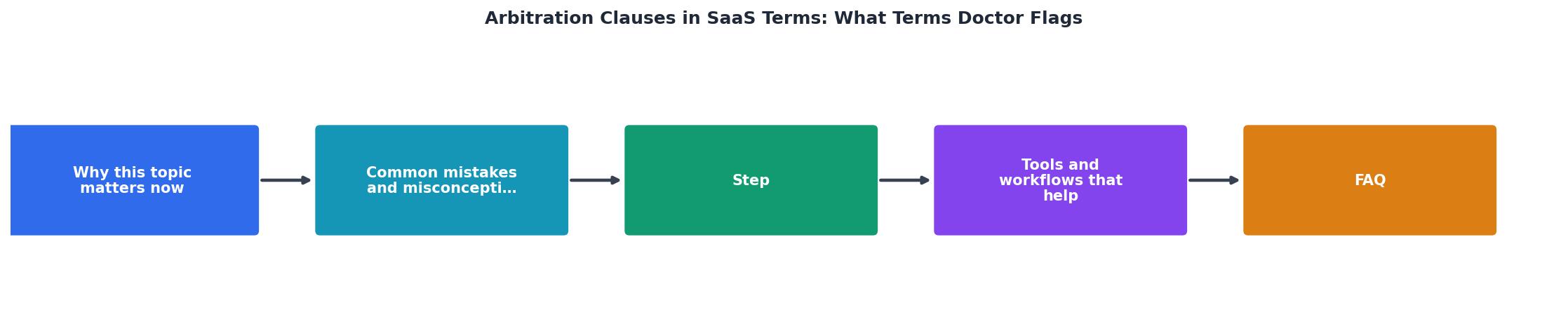
Terms Doctor is a free browser extension for Chrome, Edge, Brave, Opera, and Vivaldi. When you visit any website, it automatically locates the terms-of-service page and runs 101 consumer-protection checks against the text. Here is how the arbitration-related detection works, step by step:
- Automatic ToS discovery, The extension scans the current site for links labeled "Terms of Service," "Terms and Conditions," "User Agreement," and similar variations. No manual searching required.
- Clause extraction, The full text is parsed into individual clauses and sections using natural-language segmentation.
- Pattern matching for arbitration language, Terms Doctor looks for keywords and phrase patterns such as "binding arbitration," "waive the right to a jury trial," "class action waiver," "individual basis only," and dozens of other variants.
- Severity scoring, Each detected clause is scored based on how restrictive it is. A clause with a 30-day opt-out window scores lower risk than one with no opt-out at all.
- A-F grade calculation, Arbitration findings feed into the overall A-F grade alongside the other 100+ checks (auto-renewal traps, AI data-training clauses, unilateral amendment rights, and more).
- Red-flag highlights, The specific arbitration clause is highlighted in the terms page with a plain-language explanation so you understand what you are agreeing to.
- Change tracking, If the vendor updates its terms to add or modify an arbitration clause after you first reviewed them, Terms Doctor can alert you to the change.
What to Do When You Find an Arbitration Clause

Finding the clause is only half the battle. Here is a practical checklist you can follow every time Terms Doctor (or your own reading) surfaces an arbitration provision.
Arbitration Clause Response Checklist
Your progress is saved automatically in your browser.
Negotiation tips for SaaS buyers
If you are evaluating a paid SaaS tool, especially at the team or enterprise tier, you often have more leverage than you think. Vendors regularly agree to addendums that carve out arbitration requirements for customers above a certain spend threshold. Ask for:
- Removal of the class-action waiver.
- Mutual agreement on a neutral venue (not the vendor's home state).
- The right to litigate claims above a specified dollar amount.
- A longer opt-out window written into your order form.
When arbitration is not all bad
To be fair, arbitration can sometimes benefit consumers too. It is generally faster than court litigation, and some arbitration bodies have consumer-friendly fee caps. The AAA, for instance, limits consumer filing fees to $200 for claims under $75,000 under its Consumer Arbitration Rules. If your dispute is straightforward and low-value, arbitration might actually resolve it more quickly than a court would. The key is knowing what you are agreeing to before you need it.
Real-World Red Flags Terms Doctor Catches
Beyond the core arbitration clause, Terms Doctor flags several related provisions that amplify the risk:
- Unilateral amendment rights, The vendor can change the arbitration terms at any time without notifying you. Combined with forced arbitration, this means the rules can shift after you have already committed.
- Fee-shifting clauses, If you lose the arbitration, you may be required to pay the vendor's legal fees.
- Confidentiality requirements, You cannot publicly discuss the outcome, which prevents community awareness of problematic vendor behavior.
- Survival clauses, The arbitration requirement survives termination of your account, meaning it applies even after you stop using the service.
- Delegation clauses, Even the question of whether a dispute is subject to arbitration is decided by the arbitrator, not a court.
Frequently Asked Questions
Take Control Before You Click "I Agree"
Arbitration clauses are not going away, if anything, they are becoming more common as SaaS vendors look to limit legal exposure. The best defense is awareness, and that starts with actually knowing what is in the terms you accept. Install the free Terms Doctor extension for Chrome, Edge, Brave, Opera, or Vivaldi, and let it surface forced-arbitration clauses, class-action waivers, and 99 other consumer-protection red flags automatically. It takes seconds, costs nothing, and puts you back in control of what you agree to.
Reminder: Terms Doctor is an informational tool, not a law firm. Its checks are not legal advice. When in doubt, consult a qualified attorney.
Additional Resources
- Everything you need to know about SaaS agreements - Ace SaaS agreements: Learn key clauses, pitfalls, tips for crafting effective SaaS contracts, including SaaS management.
- 9 Clauses You Can Steal From SaaS Apps - Arbitration Limitation of Liability clause This clause. DocuSign includes information about arbitration and other legal issues in its Terms and ...
- Customer SaaS Agreement - Scenario Cloud - The dispute regarding the remainder may be referred to the dispute resolution procedure prescribed by this SaaS Agreement.