
Photo by Markus Winkler from Pexels
Artificial intelligence is no longer a futuristic buzzword, it is baked into the tools you use every day, from email clients and design apps to customer-support chatbots and code editors. What many users miss is that the terms of service (ToS) for these products now contain AI-specific clauses that can quietly grant companies sweeping rights over your data. This guide walks you through the exact language patterns to watch for, explains what each clause really means in plain English, and shows you how to protect yourself before you click "I Agree."
TL;DR
- Many SaaS products now include clauses that let them feed your content into AI training datasets, often buried deep in the ToS.
- Key red flags include broad "license to use" language, vague references to "machine learning" or "service improvement," and opt-out mechanisms that are hard to find.
- AI-generated output ownership is rarely addressed clearly, leaving you uncertain about who owns what you create with the tool.
- Forced arbitration and class-action waivers often accompany AI clauses, limiting your legal options if something goes wrong.
- Tools like the free Terms Doctor extension can automatically surface these clauses so you don't have to read every word yourself.
Why AI Clauses Matter More Than Ever

A few years ago, the biggest concern in a terms-of-service document was whether the company could change its pricing without notice. Today, the stakes are higher. When a platform says it may use your "inputs and outputs" to "improve its services," that often means your data, your prompts, your uploaded files, your creative work, could end up in a training dataset that powers the company's next AI model.
This is not hypothetical. Major platforms have already updated their terms to include exactly this kind of language. In some cases, the clause is a single sentence tucked inside a 10,000-word document. In others, it is spread across multiple sections, the main ToS, a separate privacy policy, and an AI-specific addendum, making it nearly impossible to piece together the full picture without dedicated effort.
"The prevailing definition from the Organisation for Economic Co-operation and Development (which is used, for example, in the Colorado AI Act) defines AI broadly.">, Key Considerations in AI
That broad definition means almost any "automated decision-making" or "machine learning" feature can fall under the AI umbrella. If the terms reference any of those phrases, you should read the surrounding sentences very carefully.
The Six AI Clause Categories You Need to Know
Not all AI clauses are created equal. Below is a breakdown of the six most common categories, what they look like in practice, and why each one matters to you as a user.
1. Data-for-Training Clauses
What it looks like: "You grant us a worldwide, royalty-free license to use, reproduce, and create derivative works from your Content for the purpose of operating, improving, and developing our Services, including AI and machine-learning models."
Why it matters: This is the broadest and most impactful clause. It means anything you upload, documents, images, code, chat logs, can be used to train the company's AI. Once your data is in a training set, there is no practical way to remove it.
2. AI-Output Ownership Clauses
What it looks like: "As between you and the Company, you own the output generated by the Service, subject to the terms of this Agreement and any applicable third-party rights."
Why it matters: The phrase "subject to" is doing a lot of heavy lifting. It often means the company retains a license to the output, or that ownership is conditional on your compliance with every other term. If you violate any clause, even unknowingly, your ownership claim could evaporate.
3. Automated Decision-Making Disclosures
What it looks like: "We may use automated systems, including AI, to make decisions that affect your account, including content moderation, fraud detection, and eligibility determinations."
Why it matters: Under regulations like the EU's GDPR (Article 22), you have the right not to be subject to decisions based solely on automated processing. If a platform uses AI to suspend your account or deny a refund, you may have the right to request human review, but only if you know the clause exists.
4. Opt-Out Mechanisms (or Lack Thereof)
What it looks like: "You may opt out of AI training by visiting your account settings and toggling the 'Data for AI' switch to Off."
Why it matters: An opt-out is better than nothing, but the default is almost always opt-in. Many users never find the toggle. Worse, some platforms bury the opt-out in a separate form or require you to email a specific address within a narrow time window.
5. Third-Party AI Sub-Processor Clauses
What it looks like: "We may share your data with third-party service providers, including AI sub-processors, to deliver and improve the Service."
Why it matters: Even if you trust the primary company, your data may flow to a third-party AI provider whose own terms are far less protective. You rarely get to review or consent to those downstream terms.
6. Indemnification and Liability Limitations for AI
What it looks like: "The Service's AI features are provided 'as is.' We disclaim all warranties regarding the accuracy, completeness, or reliability of AI-generated outputs."
Why it matters: If an AI tool gives you incorrect legal advice, flawed code, or misleading financial data, this clause means the company accepts zero responsibility. You bear the full risk.
How to Spot These Clauses: A Step-by-Step Guide
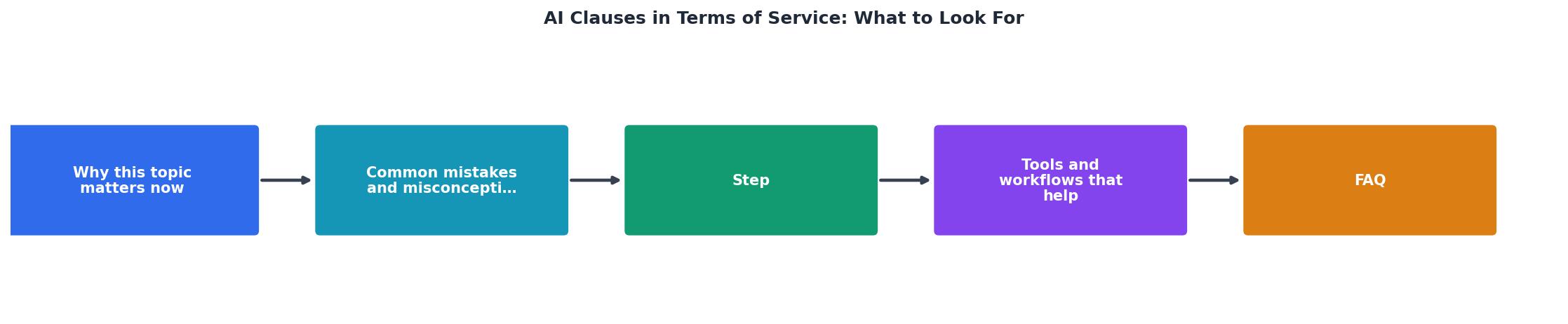
Finding AI clauses manually is tedious but possible. Here is a repeatable process you can follow every time you sign up for a new tool:
- Locate all relevant documents. Don't stop at the main ToS. Check the privacy policy, acceptable-use policy, data-processing agreement (DPA), and any AI-specific addendum or FAQ page.
- Search for AI keywords. Use Ctrl+F (or Cmd+F) and search for: artificial intelligence, machine learning, AI, automated, training, model, algorithm, generative, and output.
- Read the surrounding paragraph. A keyword hit alone is not enough. Read the full paragraph to understand the scope of the clause, does it apply to all users or only certain tiers? Is it limited to anonymized data or does it include identifiable content?
- Check for opt-out options. If the clause mentions AI training, look for any opt-out mechanism. Note whether it is a toggle in settings, an email request, or a form submission, and whether there is a deadline.
- Look for liability disclaimers. Scroll to the "Limitation of Liability" or "Disclaimers" section and check whether AI outputs are specifically excluded from any warranty.
- Compare with previous versions. If you are already a user, check whether the company has a changelog or "last updated" date. Terms Doctor's change-tracking feature can alert you when a ToS you have previously reviewed gets modified.
- Document your findings. Keep a simple spreadsheet or note with the service name, the clause type, the exact quote, and whether you opted out. This record is invaluable if a dispute arises later.
Your AI Clause Review Checklist

Use this checklist every time you evaluate a new service. Print it out, bookmark it, or keep it in your project-management tool.
AI Clause Review Checklist
Your progress is saved automatically in your browser.
Real-World Red Flags to Watch For

Beyond the six categories above, here are specific language patterns that should immediately raise your guard:
- "Aggregate and de-identified data", Sounds safe, but re-identification is a well-documented risk. If the clause does not specify the de-identification standard used, treat it as a red flag.
- "Including but not limited to", This phrase makes any list that follows it non-exhaustive. The company can add new uses (like AI training) without updating the terms.
- "At our sole discretion", When paired with AI features, this means the company can change how AI processes your data at any time, without notice or consent.
- "You acknowledge and agree", Often precedes a clause that waives a right you would otherwise have. If it appears near AI language, read it twice.
- "Feedback", Some terms define any interaction with an AI feature as "feedback," which the company then owns outright. This can include your prompts, corrections, and even the way you edit AI-generated text.
How Terms Doctor Helps You Stay Protected
Reading every word of every terms-of-service document is not realistic. The average ToS is longer than most short novels, and AI clauses are often scattered across multiple pages. That is exactly the problem Terms Doctor was built to solve.
The free Terms Doctor browser extension, available for Chrome, Edge, Brave, Opera, and Vivaldi, automatically finds the terms of service on any website you visit. It runs 101 consumer-protection checks, including specific checks for AI-training clauses, data-for-model-improvement language, AI-output ownership gaps, and forced-arbitration provisions. Each site gets a clear A-F grade with plain-language explanations of every flagged issue. If a company updates its terms after your initial review, Terms Doctor's change-tracking feature alerts you so you can reassess.
You don't need to be a lawyer to protect yourself, you just need the right tool. Install the free extension from the Terms Doctor homepage and start reviewing terms in seconds instead of hours.
Note: Terms Doctor's automated checks are informational and do not constitute legal advice. For specific legal questions, consult a qualified attorney.
Frequently Asked Questions
Additional Resources
- AI Terms of Use (Clickwrap) - Practical Law) - Key provisions define concepts such as AI input, AI output, and training data, and outline the parties' respective rights and obligations concerning ...
- Tailoring AI Contract Clauses to a Nonprofit's Unique Needs - Quite simply, a one-size-fits-all approach is not advisable. The best AI clauses are tailored to specific use cases and implement appropriate ...
- Key Considerations in AI-Related Contracts | Byte Back - Ultimately, the company's use case for the AI product/service will dictate what contractual terms are the most significant. For example, if ...